Tag Archives: christianity

Refuge for a Nation in Ruin | Bible Gleanings | September 20-21, 2025

โ€œIf the foundations are destroyed, what can the righteous do?โ€ (Psalm 11:3). In light of the abominable and anti-American tragedies that have occurred in recent days, many believers are asking this question. The assassination of Charlie Kirk, murder of Iryna Zarutska, and continual school shootings have left many believers helpless and hopeless. What can American Christians do when the fundamental cornerstone of free speech is threatened by the bullets of political extremists? What can we do when there are no longer any safe spaces from such violence? 

First, we must recognize the problem. The moral foundations of our great nation are eroding. For decades, the federal government has attempted to redefine, and thereby undermine, the societal groundwork that holds America together. A moral society cannot survive when it jettisons basic truthsโ€”truths found most of all in the Scriptureโ€”truths such as: God-ordained marriage is between one man and one woman for life (Gen. 2:24); you are the gender your chromosomes say you are (Gen. 1:27); children in the womb should not be slaughteredโ€”but protected by the law (Psalm 139:13-16); those who take human life should be penalized to the highest extent of the law (Gen. 9:6); and the governmentโ€™s job is to inflict terror upon evildoers which, therefore, allows morality to flourish on its own (Rom. 13:3-4).

Second, we mustย reviveย our concern for our country. Believers in Christ must not retreat into the shadows, rather, we must expose the works of darkness and bring Christianity back into the public square (Acts 17:16-34; Eph. 5:11), never backing down from speaking the truth in love (Eph. 4:15). We must love harder and proclaim the gospel of Christ bolder than ever (Mark 12:31; 16:15). We must work harder than ever before to rebuild our nationโ€™s crumbling moral foundations. And to spread salt and light throughout our society (Matt. 5:13), we must elect and support lion-hearted and constitution-following men and women who possess unbreakable moral backbones, and refuse to settle for anything less.

Third, we must takeย refugeย in the Lord (Psalm 11:1; Prov. 18:10). This doesnโ€™t mean retreating into our prayer closets and ignoring the ills around usโ€”it means relying upon the Lord in the midst of trouble. Taking refuge in the Lord does not mean fleeing from the battle, but having faith in God during the battle. More than ever, we must believe against what our eyes seeโ€”trusting that God is still good, His word is still true, His promises are still trustworthy, His sovereignty is still real, His providence is still active, and His plan cannot be thwarted. And part of trusting in God is repenting of our trust in the golden calf of politics. Neither the donkey nor the elephant can save us or our nation, but the Lamb of God can.


Brandon is the pastor of Bandana Baptist Church in Bandana, Kentucky, where he lives with his wife, Dakota, and their three dogs, Susie, Aries, and Dot. Brandon and Dakota are also foster parents through Sunrise Children’s Services of Kentucky. Brandon is also a published author and a religious columnist for the Advance Yeoman newspaper in Ballard County, Kentucky. He is also a devotional contributor for Kentucky Today, a news publication of the Kentucky Baptist Convention. His columns are also featured in the Times-Argus newspaper of Central City, Kentucky, West Kentucky News of western Kentucky, and the online blog, Reforming the Heart.

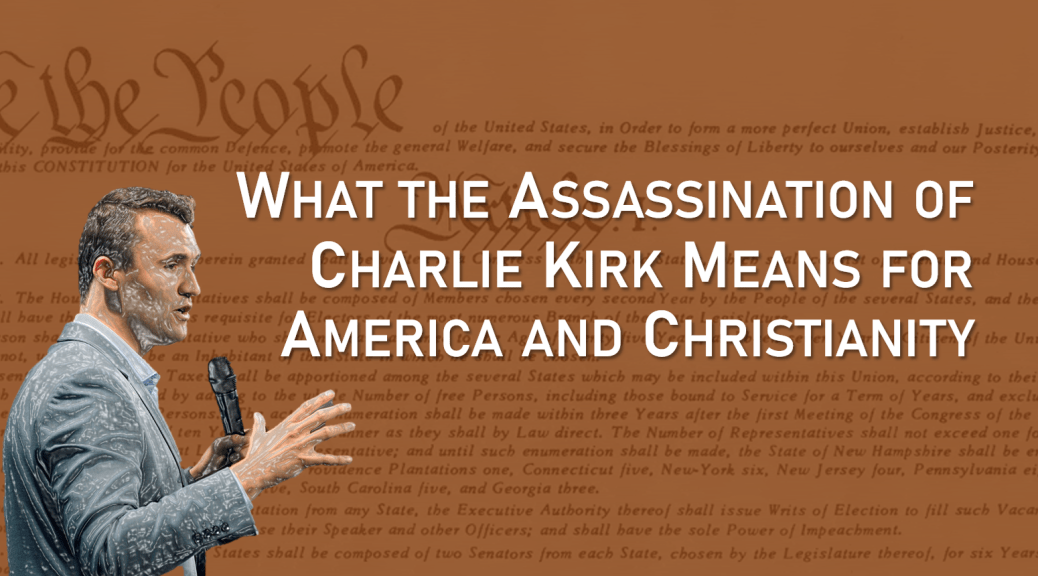
What the Assassination of Charlie Kirk Means for America and Christianity

I have abstained from commenting on the abominable and anti-American tragedies that have occurred back-to-back recently, as my indignation has tempted me to speak unkindly and unhelpfully. But now that I have had time to allay my anger, pray for wisdom, and contemplate the biblical, historical, and national ramifications of what I believe has changed the United States overnightโ€”for better or worseโ€”here are a few observations:

1. This is not the America I wantโ€”not the America any of us want. The humanity, morality, and decency we possessed following the catastrophe of September 11, 2001 has largely diminished. And I want it back. I yearn for the America of yesteryear when politics was a take-it-or-leave it issue, seldom dividing everyday Americans.

2. Contrary to popular belief, religion has not become increasingly politicalโ€”politics have become more religious. The political realm has invaded and usurped fundamental matters of morality, to our detriment. For decades, the federal government has encroached upon marriage, sexuality, and human life at its most precious stage. And know thisโ€”its futile attempt to redefine, and thereby undermine, these societal cornerstones has brought us to this moment. These tragedies are symptoms of a moral disease.

The United States cannot and will not exist so long as these erosions continue. As John Adams said, โ€œOur constitution was made only for a moral and religious people. It is wholly inadequate to the government of any other.โ€ This is not Christian nationalism. I am not even saying our laws must necessarily follow the Bible. But, a moral society cannot survive when it jettisons basic truthsโ€”truths found most of all in the Scriptureโ€”truths such as:

– God-ordained marriage is between one man and one woman for life.

– You are the gender your chromosomes say you are.

– Children in the womb should not be slaughteredโ€”but protected by the law.

– Those who take human life should be penalized to the highest extent of the law.

– The governmentโ€™s job is to inflict terror upon evildoers which, therefore, allows morality to flourish on its own.

3. You have the right to vehemently disagree with my views on these matters. And I would die for your right to speak freely and dissent. I will stand beside you as an American, regardless of your political affiliation. You are my neighbor, and I love you. But no bullets should be fired because we disagree.

4. Politics has evolved into a god many are willing to die and even kill for. This golden calf must be smashed to smithereens. Vote how you will vote, speak freely about what you believe, but leave it at that.

5. We must devise a way to legislate political terrorism out of existence, while preserving free speech rights. Freely expressing opinions and even rigorously criticizing a politician or party is one thing, but demonizing a demographic simply because of their beliefs, justifying violence against them, even encouraging it, I believe, ought to be classified as hate speech, and therefore, punished. Criticize and critique whom you will, but it is carelessly irresponsible and inhumane to call any politician โ€œHitler,โ€ to classify millions of Americans as โ€œa basket of deplorables,โ€ and it is reprehensible to call for violence against your political opponents such as Rep. Maxine Waters who said years ago,

โ€œAnd if you see anybody from that Cabinet in a restaurant, in a department store, at a gasoline station, you get out and you create a crowd. And you push back on them. And you tell them theyโ€™re not welcome anymore, anywhere.โ€

This is not entirely one-sided. It is not even two-sided because most Americans do not speak this way. But the fringe fanatics doโ€”regardless of their partyโ€”and their extreme rhetoric, which tones down following a tragedy and amps up a week afterwards, may require punishment from the law to curb it. I will admit, I do not know the solution to this, but we have to find a way to eradicate it from public discourse.

6. None of us are invincible. Neither Iryna Zarutska, Charlie Kirk, nor the children who lost their lives in recent shootings anticipated the day they tragically passed. I do not diminish the gravity and severity of their awful deaths, but all of the living should take this to heart: death is inevitable and often sudden. It is inescapable. Therefore, I plead with you: repent and believe in Christ Jesus. Only He can grant everlasting life. And no excuse for not doing so is not worth losing your own soul.

7. We all must do better. We have no other choice. We must engage in healthy and in-person dialogue more often, and learn to agree to disagree and move on. And believers in Christ, we must not retreat into the shadows. More than ever, we must expose the works of darkness and bring Christianity back into the public square.

Frankly, we cannot afford for even one day more to sit on the sidelines and seal our lips about the moral erosion of our culture. We must speak the truth in love much louder. We must love harder than ever before and proclaim the gospel of Christ bolder than ever. And we must elect and support lion-hearted and constitution-following men and women who possess unbreakable moral backbones, and refuse to settle for anything less.


Brandon is the pastor of Bandana Baptist Church in Bandana, Kentucky, where he lives with his wife, Dakota, and their three dogs, Susie, Aries, and Dot. Brandon and Dakota are also foster parents through Sunrise Children’s Services of Kentucky. Brandon is also a published author and a religious columnist for the Advance Yeoman newspaper in Ballard County, Kentucky. He is also a devotional contributor for Kentucky Today, a news publication of the Kentucky Baptist Convention. His columns are also featured in the Times-Argus newspaper of Central City, Kentucky, West Kentucky News of western Kentucky, and the online blog, Reforming the Heart.

Let It Snow | Bible Gleanings for Advent | December 7-8, 2024

Nothing is more enchanting than waking up to a blanket of snow covering the neighborhood on Christmas morning. Nearly everyone dreams of a white Christmas because snow makes it feel like Christmas. Without snow, there are no snowmen, snowball fights, or โ€œdashing through the snow in a one-horse open sleigh.โ€ Christmas and snow go together like hot cocoa and marshmallows. 

Snow is also a biblical symbol for righteousness and purity. Snow was the purest form of white to the Jewsโ€”nothing was as perfect and pure. Not to mention, the fluffy flakes covered the filth and dirt of the earth. It is no wonder that people in Scripture sought to be as pure as snow, such as David, who prayed, โ€œPurge me with hyssop, and I shall be clean; wash me, and I shall be whiter than snowโ€ (Psalm 51:7). The prophet Daniel also used this imagery to describe God who is uncompromisingly pure and holy: โ€œAs I looked, thrones were placed, and the Ancient of Days took his seat; his clothing was white as snowโ€ (Daniel 7:9a).

The Lord reminded His people in Isaiah 1:18 that they were not as white as snow: โ€œCome now, let us reason together, says the LORD: though your sins are like scarlet, they shall be as white as snow; though they are red like crimson, they shall become like wool.โ€ Their sins were like โ€œscarlet,โ€ which is as red as red can be. They were stained, and the sin that colored their lives needed to be washed away. And God promised that they could be made white like snow if they turned to Him in repentance (cf. vv. 19-20). Despite being engulfed in sinโ€™s filth, they could be snow-white by the Lordโ€™s thorough washing. 

You also need the Lord to cleanse you of sin. Paradoxically, the blood of Jesus Christ is the only sufficient means of being purified from sinโ€™s crimson stain. As John the apostle said, โ€œThe blood of Jesus his Son cleanses us from all sinโ€ (1 John 1:7b). His death makes you whiter than snow in the sight of God because He clothed Himself in the filthy rags of your sin and, in exchange, gives you the white robes of His righteousness (2 Cor. 5:21). You receive this cleansing when you repent of your sins and trust completely in Christ alone for your salvation (Acts 17:30; Ephesians 2:8-9). 

Unfortunately, sin will still make you muddy every now and then. And Jesus will continue to wash you when it does. That is why, whenever you sin, you must plead the words of James Nicholsonโ€™s hymn, โ€œWhiter Than Snowโ€

โ€œLord Jesus, for this I most humbly entreat,

I wait, blessed Lord, at Thy crucified feet;

By faith, for my cleansing I see Thy blood flow,

Now wash me and I shall be whiter than snow.โ€

Brandon is the pastor of Bandana Baptist Church in Bandana, Kentucky, where he lives with his wife, Dakota, and their three dogs, Susie, Aries, and Dot. Brandon and Dakota are also foster parents through Sunrise Children’s Services of Kentucky. Brandon is also a published author and a religious columnist for the Advance Yeoman newspaper in Ballard County, Kentucky. He is also a devotional contributor for Kentucky Today, a news publication of the Kentucky Baptist Convention. His columns are also featured in the Times-Argus newspaper of Central City, Kentucky, West Kentucky News of western Kentucky, and the online blog, Reforming the Heart.

3 Important Reasons to Study Church History

โ€œIf you don’t know history, then you don’t know anything. You are a leaf that doesn’t know it is part of a tree.โ€โ€”Michael Crichton.

Studying the history of any field or subject is important. For Christians, there is perhaps no historical study more important than the study of our Christian heritage and history. For several reasons, studying church history is important, and I would argue necessaryย to truly appreciating and understanding the Christian faith. What then, are the reasons for studying church history?

1. Christianity is a historical religion.ย As I said above, knowing the history ofย anyย field is important – especially the history of Christianity. It can be confidently said that Christianity has made manyย positive contributions to the world we now live in. More in fact, than any other movement, religion, or individual in the history of the world. Further, the wavesย made by the towering individualsย of church history have rippled into our own theologies and practices, and they deserve a hearing. That’s where church history comes in. In this field of study, we can sit with individuals such as Irenaeus who combated early heresies, Tertullian who contributed to the doctrine of the Trinity, and Basil of Casearea who strengthened peoples understanding of the Spirit. We can be discipled by the greatest theologians who ever lived like St. Patrick, Thomas Aquinas, Augustine, Martin Luther, John Calvin, and many others. Christianity didn’t beginย yesterday. It has a history, like everything else, and it deserves to be studied, or what it is today will notย be appreciated to the full extent that it could be.

2. To correct mistaken views about what has happened in history.ย This is, perhaps, one of the most vital reasons for studying church history. There are many concepts in theology and many practices in churches of different denominations that have not always existed.ย Many seem to have the understanding that our denominations, beliefs and practices have always been what they are today. However, Baptist churches haveย notย always existed. Neither have Pentecostals been around for centuries, along with Methodists, Presbyterians, and other mainline denominations. Also, Roman Catholicism was not the first form of Christianity; it has not always been what it is today. It was, by no means, the dominant form of Christianity since the time of the apostles. These are only a few examples, and if church history is actuallyย studied,ย these mistaken views can be corrected.

3. Spiritual Nourishment.ย This is a very practical reason for studying church history. God spoke throughout church history, just as He does today. God hasย neverย been silent. God revealed many things to individuals of church history, and it would be foolish to think that we are more intelligent than they were. For the most part, they read the same Bible that we have today. Charles Spurgeon remarks about the ignorance of not studying what God has revealed to them: “It seems odd, that certain men who talk so much of what the Holy Spirit reveals toย themselves,ย should think so little of what he has revealed toย others.“ยน The theologians of church history will serve spiritual nourishment to us today through their defenses of Christian doctrine against the earliest heresies, their rich interpretation of Scripture, and their brilliant philosophies.

Church history deserves our careful consideration and study. There are several other important reasons for studying church history, but these three cast the net widely, and I think rightfully so. Would you agree? What would you add to the list? What would you change or take away?


1. Citedย in Rediscovering the Church Fathers,ย by Michael A. G. Haykin (Wheaton, IL: Crossway, 2011),ย 14.