You rarely notice it happening—but if it ever ceased, the whole world would notice. It happens in the mountain streams—they generously pour themselves into lakes only to be replenished by rain. What they give always comes back. It happens in the clouds above you. These rolling giants bountifully bless the earth with rainfall only to be refilled with the rising mists of evaporation. What they give away is always given back.
This is not just the way things work in nature—this is how God’s economy of blessing works as well. Believers are blessed to be a blessing to others, and blessings come to those who bless. As Solomon assured, “Cast thy bread upon the waters: for thou shalt find it after many days” (Eccl. 11:1, KJV). Proverbs similarly states, “Whoever is generous to the poor lends to the LORD, and he will repay him for his deed” (Prov. 19:17). Jesus also taught the same truth: “Give, and it will be given to you. Good measure, pressed down, shaken together, running over, will be put into your lap. For with the measure you use it will be measured back to you” (Luke 6:38).
Believers can bless others through burden-bearing, need-meeting, forgiveness-giving, truth-telling, and countless other Spirit-empowered actions. And those who do experience a “boomerang effect,” wherein God richly replenishes what is given—either in this life or the next (Matt. 19:29). It happens like this: “Whoever brings blessing will be enriched, and one who waters will himself be watered” (Prov. 11:25). Paul also spoke of this divine pattern in 2 Corinthians 9:6, “The point is this: whoever sows sparingly will also reap sparingly, and whoever sows bountifully will also reap bountifully.” God notices when you lavishly give your time, talents, and treasures to others, and that’s when He opens the windows of heaven to “pour down for you a blessing until there is no more need” (Mal. 3:10).
The hoarding Christian who never gives becomes like the stagnant and lifeless Dead Sea, which only receives water but never gives it. A garden plant heavy with fruit will collapse and wither if it doesn’t release what it bears. A soaking sponge never wrung out will eventually grow moldy. A well never drawn might be full, but it quenches no one’s thirst with its water locked away. Likewise, stashing away and stockpiling our blessings willfully interrupts God’s cycle of blessing, resulting in spiritual decay, disintegration, and dryness.
Of course, we do not give just to get. We give to please the Lord, not to manipulate His process of blessing. In obedience to God, the widow woman from Zarephath gave Elijah the little oil and flour she had left, and God provided her with a feast of bread, and the resurrection of her son (1 Kings 17:8-24). Mary of Bethany anointed Christ with a costly jar of perfume to honor her Lord, not to gain a blessing—and yet, she is honored every time the gospel is preached (Mark 14:3-9). We give for the glory of God and the good of others. But often, when blessing others, we are blessed all over again.
Brandon is the pastor of Bandana Baptist Church in Bandana, Kentucky, where he lives with his wife, Dakota, and their three dogs. Brandon and Dakota previously served as foster parents through Sunrise Children’s Services of Kentucky. Brandon is also a published author and his Bible Gleanings columns are featured in over sixteen publications throughout Kentucky, Illinois, Tennessee, and Indiana. He is also a devotional contributor for Kentucky Today,a news publication of the Kentucky Baptist Convention, and an editor at Reforming the Heart.
They couldn’t believe what they were seeing, but what they heard was even more unbelievable. The words of commendation stunned and silenced the whole crowd. They concluded that the woman had acted carelessly. She was wasting precious time and money, they thought. But the One whose estimation matters the most applauded her with six little words that speak volumes: “She has done what she could” (Mark 14:8a).
This was the humble woman, Mary, who poured an expensive alabaster flask of ointment upon the head of the Lord Jesus, while He ate dinner at the house of Simon the leper (Matt. 26:6-13; John 12:1-8). Bystanders angrily criticized her, saying, “Why was this ointment wasted like this? For this ointment could have been sold for more than three hundred denarii and given to the poor” (Mark 14:4-5a). Indeed, it seemed like she was pouring money down the drain, since the flask was worth more than three-hundred days’ wages. Nevertheless, Jesus was worth more to Mary than all the world’s silver or gold. And more importantly, Jesus didn’t think it was a waste—and He commended Mary for giving her very best to Him.
And thus, Mary joined the hall of biblical heroes and heroines who gave their all to the Lord, whether it was much or little. She joined the ranks of ancient saints like the widow woman from Zarephath, who gave God her last fistful of flour and tablespoon of oil (1 Kings 17:8-16). She gave what she could, like the young lad who gave Jesus his sack lunch, so He could multiply it (John 6:6-14). She offered everything she had to Jesus, just as the “anonymous donor” in the Gospels gave Jesus a donkey for transportation and an upper room free of charge (Mark 11:3-6; 14:13-16). She gave her best to Christ, just like Nympha who donated her house to the Lord, and Barnabas who gave the proceeds of his fields to the church (Col. 4:15; Acts 4:36-37).
When you give your all to the Lord, whether it is great or small, it is always pleasing in His sight. And this is because the Lord values quality over quantity. He measures the sincerity and generosity of your heart, not the sum or size of your offerings. Even the smallest act of sacrifice is significant in His eyes, as it reflects your love for Him. He sees and knows, dear believer: “Behold, the eye of the LORD is on those who fear him, on those who hope in his steadfast love” (Psalm 33:18; cf. Heb. 6:10). Will you join the ranks of faithful saints who gave their all to the Lord, no matter how great or small it was?
Bible Gleanings is a widely-read weekend devotional column, written for the Murray Ledger & Times in Calloway County, Kentucky.
Brandon is the founder and main contributor to Brandon’s Desk, the blog with biblical resources from his ministry. He pastored the family of believers at Locust Grove Baptist Church in Murray, Kentucky for six years. He and his wife Dakota live there with their three dogs, Susie (Jack Russell), Aries (English Shepherd), and Dot (Bluetick Beagle).
For more devotional entries like this, check out Brandon’s latest book, Bible Gleanings Volume II, which features 100 daily devotionals gleaned from God’s word:
It was a gigantic gift, but something wasn’t right. In 34 BC, the Roman general Mark Antony gave Cleopatra and her children a copious collection of territories in an event known as the Donations of Alexandria. Foregoing meager gifts of gems and gold, Antony went above and beyond by awarding them the lands of Syria, Cyrenaica, Armenia, and Parthia. In response to such a prodigious present, most people would say, “Oh, you shouldn’t have!” And given that Antony neither possessed nor was authorized to give away these lands, such a reaction would have been entirely justified!
His “gift” to Cleopatra was also incredibly disproportionate to the assets she already possessed. She had an estimated $95.8 billion in today’s dollars, making her one of the wealthiest women in history. That’s like donating a penny to a billionaire who owns the factory where pennies are made! Antony thought that his land grants were a big deal, but Cleopatra was a bigger deal herself. He gave her gifts that weren’t his, and they paled in comparison to what she was actually worth.
And all of our “gifts” to the King of kings and Lord of lords are the same way. We ultimately own nothing and God supremely owns everything (Psalm 24:1). Therefore, everything we may offer to God is already His—we are simply returning to Him what He has loaned to us. We may give God our time, but all the time we have is borrowed from Him (Prov. 22:7). We can offer the Lord our wealth and treasures, but He already owns them, too: “The silver is mine, and the gold is mine, declares the LORD of hosts” (Haggai 2:8).
This does not mean God does not want us to give to Him. As a matter of fact, what He desires is that we give all of ourselves to Him: “I appeal to you therefore, brothers, by the mercies of God, to present your bodies as a living sacrifice, holy and acceptable to God, which is your spiritual worship” (Romans 12:1; cf. Matt. 22:37). He even commands us to surrender our time, talents, and treasures to Him (Eph. 5:16; 1 Peter 4:10; 2 Cor. 9:7). But nothing we could ever give the Lord is worthy of what He deserves. God’s immeasurable worth, glory, and riches will always surpass anything we can offer. Isaac Watts (1674-1748) got it right when he penned the following words in the enduring hymn, When I Survey the Wondrous Cross:
“Were the whole realm of nature mine,
that were a present far too small.
Love so amazing, so divine,
demands my soul, my life, my all.”
Bible Gleanings is a widely-read weekend devotional column, written for the Murray Ledger & Times in Calloway County, Kentucky.
Brandon is the founder and main contributor to Brandon’s Desk, the blog with biblical resources from his ministry. He pastored the family of believers at Locust Grove Baptist Church in Murray, Kentucky for six years. He and his wife Dakota live there with their three dogs, Susie (Jack Russell), Aries (English Shepherd), and Dot (Bluetick Beagle).
For more devotional entries like this, check out Brandon’s latest book, Bible Gleanings Volume II, which features 100 daily devotionals gleaned from God’s word:
“For the wages of sin is death, but the free gift of God is eternal life in Christ Jesus our Lord.” —Romans 6:23
Where did the Christmas custom of giving and receiving gifts come from? Many speculate that it is an imitation of the gifts of gold, frankincense, and myrrh that the wise men gave to Jesus (Matthew 2:11). It is also possible that the giving of gifts models the historical Saint Nicholas who gave gifts to poor children. Whatever the historical roots of tearing open presents on Christmas day, it serves as a fitting reminder of God’s gift of eternal life through Jesus. It is not a mistake that the word of God calls this a gift.
Eternal life is a gift, as Paul says in Romans 6:23. This conveys several things. First, it is given to you and is supposed to be accepted. God extends eternal life to you and you are supposed to receive it. Second, it cannot be earned—that’s why it’s a gift. You can’t work for or earn it. Third, as all gifts are an expression of life, so it is with God’s gift of eternal life—He gives it because He loves you.
All gifts have a cost and so does this one, except the cost is not paid by you—the cost was paid by God when He sent His Son to purchase eternal life. Eternal life comes freely to you because it was paid for by the death of Christ. Have you received this gift of eternal life by trusting in Jesus as your Savior? Nothing would be more of a gift to God than that you receive the gift of eternal life that He is offering to you.
Brandon is the founder and main contributor to Brandon’s Desk, the blog with biblical resources from his ministry. He is proud to be the pastor of the family of believers at Locust Grove Baptist Church in Murray, Kentucky. He and his wife Dakota live there with their three dogs, Susie, Aries, and Dot.
I just finished eating roasted turkey, dressing, corn, mashed potatoes and . . . now I’m going to have to get another plate. So while we are feeding ourselves this Thanksgiving Day, I want to offer you a plate of theology to enjoy on this great holiday. There is much to learn from the Scriptures about thanksgiving, that is, giving thanks. We’re going to glean from Psalm 100, and see a couple of principles to use while we give thanks not only today, but in our daily lives.
In Psalm 100, we have what you might call a manual for thanksgiving. In this chapter, the people of Israel were called to give thanks to the Lord. It serves as both a song and instruction on giving thanks. The Israelites would gather for worship, and this would be one of the things they would sing. This psalm/hymn was likely sung during one of their many festivals. The Israelites had a ton of festivals, and this was one of the psalms that was likely sung during one of those. This Psalm will show us how we should give thanks to the Lord, and why we should do so.
So let’s begin by reading it together.
The Text: Psalm 100, ESV
“A Psalm for giving thanks.
Make a joyful noise to the LORD, all the earth!
2 Serve the LORD with gladness!
Come into his presence with singing!
3 Know that the LORD, he is God!
It is he who made us, and we are his;
we are his people, and the sheep of his pasture.
4 Enter his gates with thanksgiving,
and his courts with praise!
Give thanks to him; bless his name!
5 For the LORD is good;
his steadfast love endures forever,
and his faithfulness to all generations.
1. A Celebration of Song (100:1-2)
Giving thanks should be expressed in song/gladness.
In verse one, we see that the whole earth is summoned to make a joyful noise to the Lord. It is an invitation to worship and give thanks that is extended to anyone: “A Psalm for giving thanks. Make a joyful noise to the LORD, all the earth! Serve the LORD with gladness! Come into his presence with singing!” (vv. 1-2)
Here, a joyful song is to be sung to the Lord. When the Israelites would gather for worship, this is one of the many ways they would express their worship of God. They used several instruments in their worship (Psalm 150:3-5). So according to this psalm, one way that we can express our thanksgiving to the Lord is by a song. Do you ever sing to the Lord? You don’t have to sing aloud to the Lord, because a song can also be in your heart.
We are also called to serve the Lord with gladness. Gladness is a feeling of joy or pleasure, to be delighted in serving the Lord. Since we are approaching the Christmas season, I want you to think back with me to Christmas when you were a kid. Now remember that gift you really, really wanted as a kid. Remember the Christmas when you actually got it? You were probably like me, and deserved coal from Santa or a bag of switches. But anyway, man opening that gift you really wanted was a joy wasn’t it? It was what you asked for, and when you opened it up, your heart was full of gladness and delight. That’s how worshiping and giving thanks to the Lord should be. We should have that same kind of gladness when we think of all the gifts God has given us.
2. A Celebration of Covenant (100:3)
Giving thanks should be intimate.
We’ve already seen that giving thanks should be expressed in song, and in this verse we see that giving thanks should be intimate. The psalmist writes, “Know that the LORD, he is God! It is he who made us, and we are his; we are his people, and the sheep of his pasture” (v. 3). As we give thanks with joyful song, we are called to know the Lord. This only makes sense, for giving thanks to the Lord can only be done if we know Him. Giving thanks to the Lord includes knowing the Lord we worship. You can’t properly worship Him without knowing Him—that is, in a personal relationship.
That’s exactly what the author of this psalm is trying to say. In fact, the Hebrew word for “know” here is yada, which means to know intimately, or to have a deep intimacy. Much like the intimacy between a husband and a wife. Isn’t it interesting that the term knew is how Genesis describes Adam and Eve’s intimate relations? In Genesis 4:1, it says that “Adam knew Eve his wife, and she conceived and bore Cain.” If you’ve ever heard someone ramble on and say yada, yada, yada, in actuality they’re saying know intimately, know intimately, know intimately!
Our relationship with the Lord is that way. In fact, the New Testament describes our relationship with Him in terms of a Bridegroom, who is Jesus, and the Bride, the Church (Matt. 25:1-13; Eph. 5:25-27; Rev. 19:6-10). So the idea here in this psalm is that we must have an intimate relationship with the Lord, and our giving thanks to Him should be personal, ongoing, and one-on-one. Our giving thanks to Him needs to be something we do in our private lives. When we get an A on a test, we should thank Him in our hearts. When we wake up, we should thank Him. When we’re about to go to bed, we should thank Him. When we read His word we should thank Him. It’s one-on-one.
Not only must we know the Lord, we also must know that we are accountable to Him: He created us, He owns us, we are His people, and we are His sheep. The psalmist talks about the ownership of God, saying that He created us, we are His, we are His people, and we are the “sheep of his pasture.” He tends to us like a faithful shepherd. These are terms that describe, once again, our closeness to the Lord. We must know Him, and because we know Him, we are His completely. So when you give thanks to the Lord, is it weak and heartless, or is it passionate and intimate? Do you understand your relationship with Him like that?
3. A Celebration of Thanksgiving (100:4)
Giving thanks should be corporate/together.
We’ve already seen that thanksgiving should be expressed to the Lord in song, and that our thanksgiving should be intimate with the Lord, but notice also that our thanksgiving should be expressed together—it should be corporate. This is another call to praise, like vv. 1-2 above. The psalmist says, “Enter his gates with thanksgiving, and his courts with praise! Give thanks to him; bless his name!” (v. 4). Notice the terms gates and courts here. This is clearly referring to corporate worship that would take place in the Old Testament temple. It is an invitation to community worship. It is a call to enter the temple of God with an attitude of thanksgiving—to enter his courts with worship and praise. This was the purpose of the Israelites’ gathering—to give thanks to the Lord. They were to give thanks as they prayed, as they read the Scriptures, as they sacrificed, and as they gave. Even Jesus did this, as we see recorded in Luke 4. Luke writes there, “And he came to Nazareth, where he had been brought up. And as was his custom, he went to the synagogue on the Sabbath day, and he stood up to read” (v. 16). He went to the Jewish place of worship on the Sabbath day and took part in the service by reading the scroll of Isaiah (see v. 17). Basically, Jesus went to church. He valued corporate worship, and so should we.
It bothers me when people say, “I’m a devoted Christian, but I don’t go to church because I don’t believe in it.” Corporate worship is laced throughout the whole of Scripture; Jesus attended corporate worship; it is how we grow in our faith and are equipped to do God’s will (Eph. 4:12-16); and the local church is the representation of the worldwide church of God scattered throughout the earth. When we gather for worship in our local churches, our services should be saturated with thanksgiving. We are to enter our sanctuary doors with thanksgiving, and as we fellowship, sing, and learn from God’s word, we are to do so in His courts with praise and thanksgiving.
4. A Celebration of God (100:5)
Giving thanks should be done because of God.
So we know that our thanksgiving should be expressed in song, it should be intimate, and it should be corporate. Finally, we see in this manual of thanksgiving that our giving thanks should be done because of God and who He is. The psalmist writes, “For the LORD is good; his steadfast love endures forever, and his faithfulness to all generations” (v. 5). Three reasons are given for giving thanks to the Lord. First, we are to give thanks because “the LORD is good.” I love the old saying, “God is good all the time, and all the time God is good.” There is so much truth in that statement. God is completely good in His nature and everything He does. We are to give thanks because He is a good God. Second, we are to give thanks because “his steadfast love endures forever.” Because He is a good God, His love for us endures forever. It is a constant love that never ends. That should definitely be a reason to give thanks to the Lord! He loves you with an eternal love! Finally, we are to give thanks because “his faithfulness [extends] to all generations.” God’s faithfulness never runs out, they are in fact new every morning (Lam. 3:23-33).
Conclusion
We’ve seen in this Psalm that our thanksgiving should be expressed in song and gladness. It should also be intimate, one-on-one with the Lord. It should be corporately expressed, together as we gather for worship. And it should be done because of our good, loving, and faithful God.
If you’re like me, every time I get new tech, I always throw away the manual. Heck, I can figure it out for myself . . . until there’s a problem. Then I have to go to the professionals and have them check it out. And most of the time it’s a simple problem that could’ve been resolved easily if I had only read the manual! Well, let us not make the same mistake in our thanksgiving lives. We have in this Psalm the very manual for thanksgiving, instructions on how to give thanks. So let us use it, cherish it, and use these principles in our lives so that our thanksgiving won’t need to be fixed or repaired.
WATCH THIS MESSAGE BELOW:
Resources from the Ministry of Pastor Brandon G. Bramlett






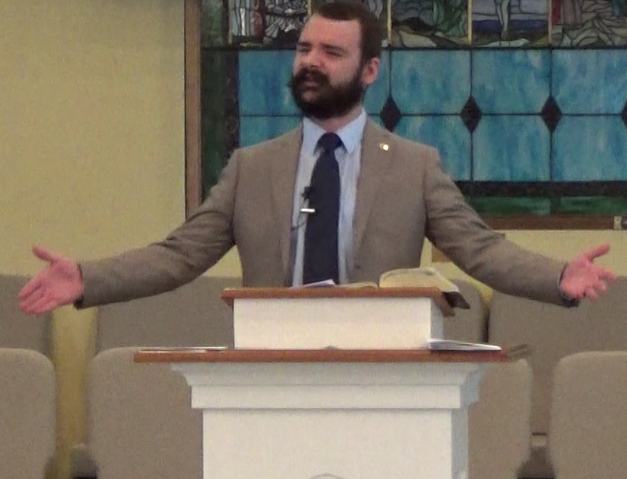 Brandon is the founder and main contributor to Brandon’s Desk, the blog with biblical resources from his ministry. He is proud to be the pastor of the family of believers at Locust Grove Baptist Church in Murray, Kentucky. He and his wife Dakota live there with their three dogs, Susie, Aries, and Dot.
 Brandon's Desk