Tag Archives: peace

The Power of Peacemaking | Bible Gleanings | March 22-23, 2025

He ordered his troops to draw their swords and prepare for a massacre. They were four-hundred strong, and the world was about to witness unprecedented bloodshed. However, thanks to the delicate intervention of one wise woman, not a single casualty ensued. As king David prepared to slaughter an irrational Nabal and all his men, an amiable and perceptive woman named Abigail brought gifts to David and negotiated skillfully (1 Sam. 25:2-38). Immediately, David and his men put away their swordsโ€”never even meeting Nabal face-to-faceโ€”and Abigail saved countless lives through one risky act of peacemaking.

And this is precisely what Jesus instructs His followers to do in the seventh beatitude of the Sermon on the Mount: โ€œBlessed are the peacemakers, for they shall be called sons of Godโ€ (Matt. 5:9). Simply put, a peacemaker is one who makes peace with others. Peacemakers do their best to live in harmony with those around them: โ€œIf possible, so far as it depends on you, live peaceably with allโ€ (Rom. 12:18). Peacemakers donโ€™t stir the pot or go to every fight they are invited to; instead, they bury the hatchet and build bridges. As Paul urged, โ€œSo then let us pursue what makes for peace and for mutual upbuildingโ€ (Rom. 14:19).

Peacemaking also entails striving to bring peace between people who are at odds with one another. Instead of starting or stoking fires, peacemakers focus on extinguishing them. Like Moses, they try to resolve conflicts between people who are better off working together (Ex. 2:13-14). They put their best foot forward to mend fences, like Jonathan who sought to reconcile David and Saul (1 Sam. 19:1-7). Peacemakers work to assist others in making amends, such as Paul, who carefully and gently endeavored to establish peace between Euodia and Syntyche, and Philemon and Onesimus (Phil. 4:2-3; Philem. 8-10).

And the most principal prerequisite for peacemaking is being at peace with God. Enemies of the Lord cannot make peace because they are at odds with Him (Rom. 5:10). Only those who are Godโ€™s friends through faith in Christโ€™s saving work may enjoy this peace: โ€œTherefore, since we have been justified by faith, we have peace with God through our Lord Jesus Christโ€ (Rom. 5:1). And this peace provides believers with a significant incentive to make peace with others. For, if God sacrificed much by sending His beloved Son to Golgotha to reconcile sinful man to Himself, how much more should saved sinners sacrifice comparatively littleโ€”like an awkward conversation or time spent in prayerโ€”to restore relationships and live at peace with others? This is why peacemaking proves that one is a child of God: โ€œfor [peacemakers] shall be called sons of Godโ€ (Matt. 5:9b).

This column is fromย 40 Days with Jesus,ย my 40-day devotional on Christโ€™s life, teachings, and miracles, available for purchase on Amazon:

Brandon is the pastor of Bandana Baptist Church in Bandana, Kentucky, where he lives with his wife, Dakota, and their three dogs, Susie, Aries, and Dot. Brandon and Dakota are also foster parents through Sunrise Children’s Services of Kentucky. Brandon is also a published author and a religious columnist for the Advance Yeoman newspaper in Ballard County, Kentucky. He is also a devotional contributor for Kentucky Today, a news publication of the Kentucky Baptist Convention. His columns are also featured in the Times-Argus newspaper of Central City, Kentucky, West Kentucky News of western Kentucky, and the online blog, Reforming the Heart.

Phony Peace | Bible Gleanings – August 19-20, 2023

โ€œDo you know how to blow up balloons, Brandon?โ€ the surgical staff asked. Of course I knew howโ€”I wasnโ€™t a sissy. In fact, one of my proudest moments as a kid was inflating a balloon by myself. But, instead of handing me a bright balloon to enjoy, the medical team strapped a mask on my face and instructed me to blow into it like I was inflating a balloon. They were administering anesthetics through it to knock me out during my tonsillectomy, and after two breaths, I was in Snoozeville. 

Anesthesia is a godsend in modern medical advancement. It is better than chomping down on a hunk of wood or chugging a bottle of whiskey to make painful procedures bearable. But the sedation-induced sleep doesnโ€™t last forever, and it doesnโ€™t compare to hitting the hay after a long day. The pain-free sleep that anesthesia provides lasts only a few hours until its effects wear off. At best, it offers temporary tranquility and peace that isnโ€™t permanent. 

The world also offers a perishable peace and spurious serenity that wears off faster than anesthesia. It lasts for only a little while, and then you wake up in distress all over again. The world may tell you that peace comes to those who follow their heart and fulfill their selfish ambitions, but the end result is always dissatisfaction and chaos. The worldโ€™s prescription for peace is found in pill and beer bottles, but such external things can never produce internal peace in the soul. And the reason the worldโ€™s peace is fleeting is because it is false.

James warned that pursuing selfish ambitions produces disorder, not peace (James 3:17). Living life for yourself results in death, not a happy and harmonious life: โ€œFor to set the mind on the flesh is death, but to set the mind on the Spirit is life and peaceโ€ (Rom. 8:6; cf. Isaiah 48:22). And peace cannot be found in drugs or alcohol, as they are simply โ€œbroken cisterns that can hold no waterโ€ (Jer. 2:13). True and lasting peace can only come from Jesus: โ€œPeace I leave with you; my peace I give to you. Not as the world gives do I give to you. Let not your hearts be troubled, neither let them be afraidโ€ (John 14:27).

The best the world can offer is anesthesia for your soul. But the โ€œGod of peaceโ€ will grant you a โ€œpeace that surpasses all understandingโ€ if you will trust in Him and believe on His Son, Jesus (2 Thess. 3:6; Phil. 4:7). And Jesus invites you to seek true peace from Him: โ€œCome to me, all who labor and are heavy laden, and I will give you restโ€ (Matt. 11:28-29). What kind of peace do you have: phony or permanent? Do you have โ€œanesthesiaโ€ for your soul, or have you come to Jesus for the real thing?

Bible Gleanings is a widely-read weekend devotional column, written for the Murray Ledger & Times in Calloway County, Kentucky. 

Brandon is the founder and main contributor to Brandon’s Desk, the blog with biblical resources from his ministry. He pastored the family of believers at Locust Grove Baptist Church in Murray, Kentucky for six years. He and his wife Dakota live there with their three dogs, Susie (Jack Russell), Aries (English Shepherd), and Dot (Bluetick Beagle).

For more devotional entries like this, check out Brandon’s latest book, Bible Gleanings Volume II, which features 100 daily devotionals gleaned from God’s word:

Weekly Expository Sermon Outline – What a Faithful Church Needs (1 Thessalonians 1:1)

Introduction: Faithfulness Greater Than Success

God makes it abundantly clear throughout Scripture that He cares more about faithfulness than success. In other words, He wants His church to be steadfast and faithful instead of โ€œsuccessfulโ€ in the worldly sense (cf. Revelation 3:7-13). God doesnโ€™t expect a local church to have thousands of members or thousands of dollars in the bank. What He expects is for all true churches to remain true to Him, His people, His word, and His mission. The body of believers at Thessalonica were a faithful church, as Paul makes apparent in every verse of this letter.

Therefore, Paul appropriately begins this letter explaining the three necessary components all churches must have in order to be faithful. What a faithful church needs are (1) faithful leaders, (2) faithful people, and (3) a faithful God.

Historical Background of First Thessalonians

Through Paulโ€™s ministry, the Lord converted souls and established a vibrant church in the busy city of Thessalonica (cf. Acts 17:1-15). But why did Paul write to them? At this point in time, Paul was separated from them due to a โ€œhindranceโ€ of Satan (1 Thess. 2:18). Therefore, he sent Timothy to check on them. Timothy brought back an encouraging report (1 Thess. 3:6-7), and Paul wrote in response to it.

I. A FAITHFUL CHURCH NEEDS FAITHFUL LEADERS (V. 1A)

โ€œPaul, Silvanus, and Timothy.โ€

The church of Thessalonica was faithful partly because of her three faithful leaders:ย 

  • Paul, the apostle. Paul founded the Thessalonian church, and he loved them dearly. Paul would have taught theology and sound doctrine, thus giving the Thessalonians a study foundation of truth. They would need biblical truth in order to live faithfully; all churches do.ย 
  • Silas, the missionary. Silas (or Silvanus), an outspoken leader of the Jerusalem church and missionary companion of Paul (Acts 15:22; 40-41), was left in Thessalonica to minister to this young church after Paulโ€™s departure. And, while Paul provided the Thessalonians with a solid foundation in truth, Silas would have instilled in them a passion for evangelism as he modeled missionary zeal. All churches need leaders like Paul to instruct, as well as leaders like Silas to imitate.ย 

  • Timothy, the young minister. Timothy, Paulโ€™s youthful ministry pupil, also stayed behind with Silas to nurture the Thessalonian church in his absence (Acts 17:14). Timothy could uniquely minister to the Thessalonians because of his young age. God used him despite having little experience or elderly wisdom. All churches can benefit greatly from raising up young leaders to love and learn from.ย 

The Point: A faithful church needs pastors, elders, deacons, and other leaders to instruct in doctrine and live exemplary lives of godliness. Certainly, a church can have the best leaders and still remain unfaithful. Remember, the plagued and sinful churches of Corinth were led by the apostle Paul himself! There can be faithful leaders without faithful churches, but there can be no faithful churches without faithful leaders. Therefore, pray for your leaders, hold them to biblical standards, and honor them with support (Gal. 6:6-10; 1 Tim. 3:1-13; 5:17).

II. A FAITHFUL CHURCH NEEDS FAITHFUL PEOPLE (V. 1B)

โ€œTo the church of the Thessalonians in God the Father and the Lord Jesus Christ.โ€

  • The church of Thessalonica was faithful because their members were saved by grace and serious about graceful living.ย 

  • Living faithfully is impossible if you are not โ€œin God the Father and the Lord Jesus Christ.โ€ If you are unsaved and out of spiritual union with God, you cannot walk in obedience. The Thessalonians were indisputably converted. Therefore, they possessed the passion and power to live faithfully, as all true Christians do.

  • As you read and study First Thessalonians, you can see just how faithful they were (which we shall see in future sermons).

The Point: A faithful church needs faithful members who will pray fervently, evangelize urgently, give sacrificially, learn eagerly, love unconditionally, and live faithfully by Godโ€™s grace in Christ. Faithfulness must come from both the pulpit and the pew.

III. A FAITHFUL CHURCH NEEDS A FAITHFUL GOD (V. 1C)

โ€œGrace to you and peace.โ€

  • The Thessalonian church was unmistakably strong and faithful because of her faithful leaders and faithful people, but they were nothing without the grace and power of a faithful God. No matter how great their leaders or how gracious their people, they could not live faithfully for even a nanosecond without the empowering grace of God.

  • Paul wishes them such grace from God, as well as peace. All believers need both in order to be faithful people.

  • Grace. You received saving grace at salvation, but you need sanctifying grace for service (cf. 2 Cor. 9:8). If we wish to be faithful believers, we must depend wholly upon Godโ€™s strengthening grace. Relying on the grace of God, you can stand strong; relying on anything else ensures a dangerous fall.

  • Peace. Believers possess peace with God, peace with others, and inward peace within the heart (Rom. 5:1; Eph. 2:11-22; Phil. 4:4-7). But we must continually plead for and pursue such peace because living faithfully is not always peaceful. Faithful living always causes conflict with those living unfaithfully. It requires that we make sacrifices, too.ย 

The Point: Without grace and peace from a faithful God, we cannot be faithful members of the Lordโ€™s church.ย 

Conclusion

Every church should want to be faithful. But faithfulness cannot be ordered from Amazon and delivered in two days. Faithfulness must be sought after. Therefore, for a church to be faithful it must have faithful leaders, faithful members, and the grace and peace which comes abundantly from Almighty God.

Brandon is the founder and main contributor to Brandon’s Desk, the blog with biblical resources from his ministry. He is proud to be the pastor of the family of believers at Locust Grove Baptist Church in Murray, Kentucky. He and his wife Dakota live there with their three dogs, Susie (Jack Russell), Aries (English shepherd), and Dot (beagle).

Better Than Santa | Bible Gleanings [Advent Edition] – December 4-5, 2021

Santa Claus is slightly judgmental. He only brings presents to good boys and girls. Those who misbehave are on the naughty list and will receive only coal in their stockings. As J. Frederick Coots and Haven Gillespie wrote in Santa Claus is Cominโ€™ to Town, โ€œHeโ€™s making a list, heโ€™s checking it twice, heโ€™s gonna find out whoโ€™s naughty or nice.โ€ Only youngsters most deserving of gifts can expect to find presents underneath the tree.

Jesus is the polar opposite of Santa: He gives the greatest gift to those who are the least deserving. He came to grant salvation and eternal life to evil people, not good people. As He Himself said, โ€œI have not come to call the righteous, but sinners to repentanceโ€ (Luke 5:32). Furthermore, He came to erase your name from the โ€œnaughty listโ€ and write it in His book, the โ€œLambโ€™s book of lifeโ€ (Revelation 21:27). 

The fact that shepherds were the first to hear the good news of Jesusโ€™ birth embodies Christโ€™s mission to save the undeserving. The glad tidings were announced by the exalted angels of heaven, not to kings or emperors, but to some of the most insignificant people in Judean society. Luke wrote, โ€œAnd in the same region there were shepherds out in the field, keeping watch over their flock by night. And an angel of the Lord appeared to themโ€ (Luke 2:8-9a). Shepherds were thought to be insignificant and contemptible. Jews considered them to be unclean, deceitful, and uneducated. Nonetheless, they were the first to hear the wonderful news that the Savior had been born.

The Gospels reinforce the idea that Jesus came for the low-ranking people of the world. The first disciples were fishermen. Jesus healed social outcasts: lepers, paralytics, and the demon-possessed. He ate with tax collectors and sinners. He cared for widows and the sexually immoral. Thereโ€™s no question about itโ€”Jesus came to save the least qualified.

You donโ€™t have to be outstandingly competent to receive His gift of eternal life. The Lord Jesus will grant salvation to you, no matter who you are or what you have done. Eternal life can be yours even if you are sexually immoral, idolatrous, adulterous, greedy, or addicted (1 Cor. 6:9-11). Jesus is the significant Savior who came for insignificant people. That is why Jesus is better than Santa. If you want to learn more about the significance of Jesusโ€™ coming to earth, check out my new Christmas devotional on Amazon: โ€œLet Earth Receive Her King: 25 Daily Advent Devotions.โ€


Bible Gleanings is a widely-read weekend devotional column, written for the Murray Ledger & Times in Calloway County, Kentucky. 

Brandon is the founder and main contributor to Brandon’s Desk, the blog with biblical resources from his ministry. He pastored the family of believers at Locust Grove Baptist Church in Murray, Kentucky for six years. He and his wife Dakota live there with their three dogs, Susie (Jack Russell), Aries (English Shepherd), and Dot (Bluetick Beagle).

Day 21: Gloria in Excelsis Deo!

โ€œGlory to Godย in the highest, and on earthย peaceย among those with whom he is pleased!โ€ โ€”Luke 2:14

Everyone is familiar with the beautiful refrain of Angels We Have Heard on High which exclaims, โ€œGloria in excelsis Deo, Gloria in excelsis Deo.โ€ Written by James Chadwick in the 1800โ€™s, most of the carolโ€™s lyrics are in English, with the exception of this well-known chorus. The phrase is the Latin rendition of what the angels declared during their heavenly jubilee as recorded in Lukeโ€™s Gospel: โ€œGlory to God in the highest.โ€ Also, in many other Christmas carols is the rest of the angelic doxology, โ€œand on earth peace among those with whom he is pleased.โ€ The KJV translation is the most recognized: โ€œGlory to God in the highest, and on earth peace, good will toward men.โ€

No phrase is more fitting to sing at Christmastime since it reminds us of what Christ made possible by His coming: glory to God and peace to men. The angels first declare that glory is to be given to God in the highest. This means that such glory is given to God who is in the highest (since He is the Most High) and it is to be given to Him in the highest degree. The birth of Christ in the Bethlehem and His corresponding work at Golgotha enables you to give glory to God in the highest degree, as you will do one day in His eternal presence if you have made Christ your Savior.

But His coming also brings peace to those with whom God is pleased to give it. The peace and well-being that God gives comes to those who please Him by turning from sin and trusting in Jesus for salvation. If you know the Savior who was born on Christmas day, you can experience peace with God (Romans 5:1), inward peace (Philippians 4:7), and peace with others (Ephesians 2:14-16). This time of year, no matter how busy or even lonely you may be, you can gleefully sing Gloria in excelsis Deo because Christโ€™s coming empowers you to glorify God and experience true peace.


_fGOro4V_400x400

Brandon is the founder and main contributor to Brandon’s Desk, the blog with biblical resources from his ministry. He is proud to be the pastor of the family of believers at Locust Grove Baptist Church in Murray, Kentucky. He and his wife Dakota live there with their three dogs, Susie, Aries, and Dot.

The Preservation of Christian Unity (Eph. 4:2-3)

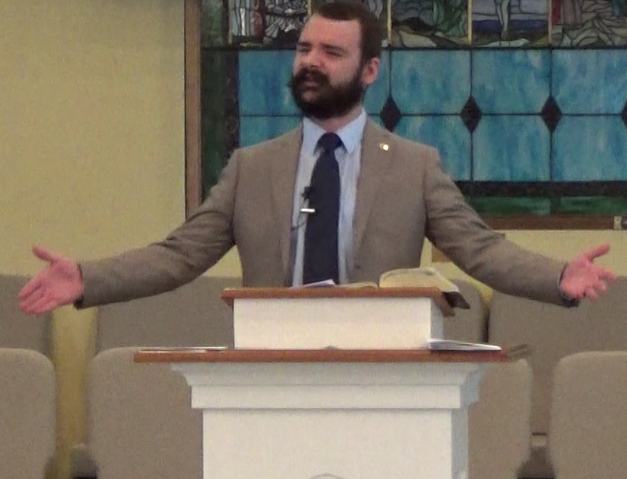
The following sermon was delivered at Locust Grove Baptist Church in Murray, Kentucky, on the 28th day of October 2018, during the evening service:


profile pic5Brandon is the founder and main contributor to Brandon’s Desk, the blog with biblical resources from his ministry. He is proud to be the pastor of the family of believers at Locust Grove Baptist Church in Murray, Kentucky. He and his wife Dakota live there with their two dogs, Susie and Aries.

Ephesians: He Himself is Our Peace (2:14-18)

The following message was delivered at Ohio Valley Baptist Church on the 24th day of November 2013:

The Design of the Death of Christ

If you care about the Son of God, if you care about the blood of Christ, if you care about the death of the greatest person who ever was, you have to care about theย designย of the death. (1) That’s where Ephesians 2:14-18 comes in. These verses form the centerpiece of this entire section (2:11-22) because they explain how the Gentile readers’ coming near to God was made possible through Christ’s death. The Gentiles, who were completely separated from Israel and her God (2:11-12) have now been brought near to Him (2:13). God’s Word to us tonight explains how.

The Text

“14 For he himself is our peace, who has made us both one and has broken down in his flesh the dividing wall of hostility 15 by abolishing the law of commandments expressed in ordinances, that he might create in himself one new man in place of the two, so making peace, 16 and might reconcile us both to God in one body through the cross, thereby killing the hostility. 17 And he came and preached peace to you who were far off and peace to those who were near. 18 For through him we both have access in one Spirit to the Father.”

He Himself Is Our Peace

“For he himself is our peace. . .” (v. 14a). This is an important, but strange affirmation about Jesus. If you’re like me, you’re used to seeing Jesus as making peace (“We have peace with God. . . through Jesus” Romans 5:1.) or as proclaiming and commanding peace (“Blessed are the peacemakers. .” Matt. 5:9). But here Paul says, “He himselfย isย our peace.” The reason Paul says this is because Jesus is the central figure in establishing peace (as you will see in this passage) between both Jew and Gentile. Christ is the central figure who effects reconciliation and removes hostility in its various forms. If you notice in 2:14-18, every time Jesus in named, He is followed by the word or phraseย peace.ย 1) v. 14 “He himself is our peace.” 2) He established peace (v. 15) 3) He came and preached peace (v. 17). And once you take a good long look at Christ’s reconciling work through the cross, you will have no wonder why Paul states, “He himself is our peace.”

Made Us Both One

“. . who has made us both one” (v. 14b). This refers to the resulting unity of Jewish and Gentile believers. Christ has made both Jew and Gentileย one.ย You may say, “Okay. Great.” But do you understand what a great accomplishment this was? The Jewsย hatedย the Gentiles. A. T. Lincoln rightly says, “In accomplishing this, Christ has transcended one of the fundamental divisions of the first-century world” (2). And that’s what makes this verse so amazing. He has madeย bothย one. They have been brought into a mutual relationship and a unity which surpasses what they once were (vv. 15, 16, 18).

How did Christ make the two one? “[He has] broken down in his flesh the dividing wall of hostility by abolishing the law of commandments expressed in ordinances” (v. 14c-15a). This is a rather strange metaphor from the apostle Paul, mainly because no such parallel exists in the entire New Testament. But by simply stating this, Paul indicates that there was aย realย dividing wall that existed between the Jews and Gentiles. There was an inscription on the wall of the outer courtyard of the Jerusalem temple warning Gentiles that they would only have themselves to blame for their death if they passed beyond it into the inner courts. This was segregation for them. If you grew up during that time, then you can best grasp what life was like for Jews and Gentiles. Though this serves as a great picture of the hostility between Jews and Gentiles, this isn’t what Paul is referring to here. The “dividing wall of hostility” was, in fact, the Mosaic law itself with its detailed holiness code. It separated Jews from Gentiles both religiously and sociologically, and caused deep-seated hostility. “The enmity which was caused by the Jews’ separateness was often accompanied by a sense of superiority on their part,” says Peter O’Brien (3). Paul isn’t ‘downing’ the Law here. Why would he count the Law as worthless when he says, “What then shall we say? That the law is sin? By no means!” over in Romans 7? Paul is saying here that what has been abolished is the ‘law-covenant,’ that is, the law as a whole conceived as a covenant. In addition, Christ said, “Do not think that I have come to abolish the Law or the Prophets; I have not come to abolish them but to fulfill them” (Matt. 5:17). It is not the Law as revealing the will and character of God that Christ has abolished, it is the ‘law-covenant.’ It is thenย replacedย by a new covenant for Jewsย andย Gentiles.

Barriers

If the Law in some way was the dividing wall in the ancient world, for us it is racial difference. The hostility between races, especially between blacks and whites, in virtually all countries continues as an embarrassment. Did Christ’s death abolish all the barriers? The barrier between Jew and Gentile was one of the most obvious in history. Ifย thisย barrier has been “broken down,” what other barrier can be justified? If God does not show favoritism (Acts 10:34-35; Romans 2:11), if all are created in His image, if God’s purpose is unity, if we are to love even our enemies (Matt. 5:44), if Christ took the hostility into Himself to destroy it, on what grounds can we justify keeping any barriers in place? Ifย thisย hostility was so deep, large, and wide that God desired it be broken down through the crucifixion of the most important person who ever was, then who do we think we are to hold prejudices and hostility against a brother or sister in Christ? “He has made us both one!”

If you belong to the family of God, “He has made us both one!” You will have differences with one another. But our differences shouldn’t create hostility because the cross is at ground level. No one has higher value than someone else in the church of God. If you are male and she’s female, if you’re rich and he’s poor, if you’re black and she’s white, if you’re Calvinist and he’s Arminian, if you wear Blue Jeans and he wears a suit, if you’re older and she’s younger, if you like Contemporary and he likes Bluegrass, if you’re country as cornbread and she’s a city-girl,ย andย if any of those things create hostility between you, remember this: None of our barriers, none of our ways of devaluing, limiting, and taking advantage of others, has any basis. “There is neither Jew nor Greek, there is neither slave nor free, there is no male and female, for you are all one in Christ Jesus” (Galatians 3:28).

Abolishing the Law

The purpose of Christ’s removing this hostility was twofold: (1) to create in Himself one new man in place of the two (v. 15b), and (2) in this one body to reconcile both of them to God (v. 16a). If Christ has broken down, crushed, and shattered the “dividing wall of hostility,” then how did He do it? The first part of verse 15 tells us. Christ brought them together in a sovereign act that was nothing less than a new creation. Paul has already spoken of Godโ€™s salvation in terms of a new creation (2:10). Believers are his workmanship who have already been created in Christ Jesus for good works, and these are part of Godโ€™s intention for that new creation. If God had in mind to create a new humanity, His church, it couldย notย take place by transforming a Gentile into a Jew and it could not take place by transforming a Jew into a Gentile, theย onlyย way it could take place was by transformingย sinnersย into new persons through faith in the Lord Jesus Christ. Reconciliation between Jew and Gentile takes place through the death of Christ by the one similarity that they actually shared: they were sinners in need of salvation.

Reconcile Us Both to God

If Christ has removed the hostility between Jew and Gentile and has reconciled the two into one body, then it follows that we must both be “reconciled to God.” Do you hear the vivid language in verse 16? “And might reconcile us both to God in one body through the cross, therebyย killingย the hostility.” What an oxymoron! While “creating in himself one new man” (v. 15), Christ alsoย killsย the hostility. Christ has abolished the law as a divisive instrument separating humanity from God and Jews from Gentiles. He has created a single new humanity that transcends the former deep divisions and made peace between them. He has reconciled both Jew and Gentile in this one body to God, killing the hostility. This does not mean, however, that the whole human race has been united and reconciled.

Is God Distant?

Sometimes, as believers, we can think of God as distant or unapproachable. This lack of a sense of the nearness to God lies at the root of much of human failure. But the Bible tells us here that we have been “reconciled to God.” In Christ, we have been brought to God, and the barriers blocking access to Him, such as sin, hostility, and the weakness of the flesh have been removed. But when we feel distant from God, it isn’t He who has moved. It is us. God asks Israel in Jeremiah 8:4-5, “When men fall, do they not rise again? If one turns away, does he not return? Why then has this people turned away in perpetual backsliding?”ย Backsliding starts in such a subtle way that most of us are not aware of it, and many of us may be backslidden and may not realize it. And while we need to fall on our face in repentance and return to God, we are no longer separated from God. J.D. Greear captures this truth by means of prayer, “In Christ, there is nothing I can do that would make You love me more, and nothing I have done that makes You love me less.” (4)

Christ the Preacher

Having dwelt at length on Christโ€™s work of reconciliation, Paul now turns to his proclamation of peace to both Gentile and Jew. “And he came and preached peace to you who were far off and peace to those who were near” (v. 17).ย The One who is โ€˜our peaceโ€™ and who made peace through His cross now announces that peace to those who were far off and those who were near. Christ Himself is the evangelist, the herald of good tidings from Isaiah, and His announcement, which is based on His death on the cross, is a royal proclamation that hostilities are at an end. You see, the Jews were near to God because they already knew of Him through the Scriptures and worshiped Him in their religious ceremonies (the outward expression of the Law). The Gentiles were “far off” because they knew little or nothing about God. Because neither group could ever be saved by good works or sincerity,ย bothย needed to hear about salvation available through Jesus. Both Jews and Gentiles are now free to come to God through Christ (v. 18).

Commanded and Commissioned

If preaching peace to all was good enough for the Man who died on the cross, then it ought to bee good enough for us. And while Christ is our example in everything, what’s more is we have beenย commandedย andย commissionedย by Christ Himself to take this message of peace to our communities, our nation, and toย theย nations (Acts 1:8; Matt. 28:19; Mark 16:15). Did you know that are 2,925 unreached people groups and 6,578 people groups where evangelical Christians make up 2% of the population? (5) We must “Go and preach the gospel to every creature” (Mark 16:15). You see, you may know a great deal about God and the teachings of Scripture, but do not forget that you were once without Christ and in need of a Savior, just like everyone else on the face of this planet. Do not forget your plight before Jesus stepped in (Eph. 2:11).

Access in One Spirit to the Father

To draw near to God and to enjoy Him forever in a new creation is both mankindโ€™s greatest good and the ultimate accomplishment of Christโ€™s earthly work of redemption. “For through him we both have access in one Spirit to the Father” (v. 18). What an appropriate conclusion to this section of Scripture! Through Him, we of different races, different interest, different social status, different economical status, different looks, have access in one Spirit to the Father. Paul’s focus here is on their (Jew and Gentile) continuing relationship with the Father which is the result of Christโ€™s act of reconciliation. This is important because if Christ has in fact “created in himself one new man (v. 15), then this verse tells us how thisย new creationย will continue to grow. The Holy Spirit will continue to apply the work of redemption to people’s lives and the Holy Spirit will continue to give new spiritual life to the undeserving. And it is the Holy Spirit who will empower us to carry this message of peace to the lost, to the dying, and to those in need of salvation.

Through this reconciliation work of Christ on the cross, we have access to the Father in a relationship with Him. It isn’t the Law that is the expression of our covenant with the Father, the sacrificial death of Jesus is the expression of our covenant with the Father. Indeed, He Himself is our peace.