Tag Archives: end

A Foretaste of Glory Divine: Rightly Understanding the Kingdom of God

The old hymn by Fanny Crosby begins with these words: โ€œBlessed assurance, Jesus is mine! Oh, what a foretaste of glory divine!โ€ This remarkable stanza reflects a lovely reality in Scripture that gives believers unwavering hope in times of tumultuous trials and troublesome temptations: we fellowship with Jesus Christ now, but this is only a preview of the eternal fellowship that is yet to come. This is what theologians refer to as the โ€œalready/not yetโ€ tension of eschatology (that branch of theology which deals with the future and last things). The โ€œalreadyโ€ refers to the blessings of salvation and the kingdom of God that believers enjoy in this age, and the โ€œnot yetโ€ refers to those same blessings which will be fully realized in the consummation when Christ returns. And this tension between the โ€œalreadyโ€ and the โ€œnot yetโ€ may be seen primarily in the Bibleโ€™s teaching regarding the kingdom of God.

The Nature of the Kingdom of God

One of the great themes of Scripture is the โ€œkingdom of God,โ€ which simply refers to Godโ€™s rule and reign in the hearts of His people who have submitted to His kingly dominion.1 The concept of the kingdom of God begins in and continues throughout the Old Testament,2 as it is dominated by a forward-looking anticipation of its arrival with the advent of the Messiah, who would restore Godโ€™s rule in the hearts of sinners whose rebellion is the result of the Fall. And at first glance, all the Old Testament expectations and prophecies regarding the kingdom of God appear to depict a literal kingdom characterized by triumphal victory, nationwide prowess, and Israelโ€™s restoration to supremacy. After all, God promised that He would gather His people, establish the throne of David forever, and send a Messiah upon whose shoulders would be everlasting government (Jer. 23:3-4; 2 Sam. 7:9-13; Isaiah 9:6). Therefore, it is only natural that the most popular Jewish vision of the kingdom of God was interpreted solely in physical and political terms. For them, the arrival of the kingdom of God would entail Godโ€™s ultimate victory over evil, Israelโ€™s vindication and restoration, and the fulfillment of all the promises made to David regarding his throne and rule.3

However, it is not until one turns the page from Malachi to Matthew that the kingdom of God is defined in terms of an invisible and spiritual nature, which is primarily emphasized by Christโ€™s own testimony regarding the kingdom. As Jesus begins His public ministry, He repeatedly demonstrates that the kingdom promised in the Old Testament was not to be reduced to a purely political or geographical concept. Rather, as theologian Herman Bavinck observed, โ€œJesus introduces a new understanding of the kingdom: it is religious-ethical and not political; it is present in repentance, faith, and rebirth, and is yet to come as a full eschatological reality.โ€4 And nowhere is this spiritual understanding of the kingdom more clearly expressed than in Jesusโ€™ response to the question of the Pharisees about the coming of Godโ€™s kingdom: โ€œThe kingdom of God is not coming in ways that can be observed, nor will they say, โ€˜Look, here it is!โ€™ or โ€˜There!โ€™ for behold, the kingdom of God is in the midst of youโ€ (Luke 17:20b-21, emphasis mine). Thus, according to Christ, the kingdom of God that He came to usher in was initially a spiritual one, inaugurated as He thwarted demonic oppression and restored the rule of God within the rebellious hearts of sinners.

Furthermore, when Jesus was pressed to claim literal kingship by Pilate, He replied, โ€œMy kingdom is not of this world. If my kingdom were of this world, my servants would have been fighting, that I might not be delivered over to the Jews. But my kingdom is not from the worldโ€ (John 18:36). Similarly, when Jesus was given the best opportunity to become an earthly king, He abandoned the scene, demonstrating that He had no interest in ruling over a purely earthly kingdom. As John wrote, โ€œPerceiving then that they were about to come and take him by force to make him king, Jesus withdrew again to the mountain by himselfโ€ (John 6:15). Finally, that the kingdom Jesus ushered in was spiritual and not physical is apparent from His statement that entrance into the kingdom requires one to be, โ€œborn again.โ€ As Jesus said, โ€œTruly, truly, I say to you, unless one is born again he cannot see the kingdom of Godโ€ (John 3:3).5

The Inauguration of the Kingdom of God

Now that it is abundantly clear that the arrival of Godโ€™s kingdom was meant to be understood in spiritual terms, it must also be emphasized that the Scripture teaches that the coming of Godโ€™s kingdom is to occur in two stages. That is, the โ€œinaugurationโ€ of the kingdom of God began with the first advent of Jesus, and the โ€œconsummationโ€ of the kingdom will commence with the second advent of Jesus. Jesus ushered in the โ€œbeginningsโ€ of the kingdom by His first coming, and the kingdom will be fully realized when Jesus returns bodily to subject all things to Himself and finish the work of redemption that He began. Thus, the kingdom of God manifests itself in two of the most significant redemptive events: the first and second coming of Christ.6 As Cornelis Venema observed, โ€œWhat from the vantage point of Old Testament expectation appeared to be a single movement has now in the New Testament become a twostage movement. Whereas the Old Testament saw only one great, future Messianic age, coinciding with the coming of the Messiah, the New Testament further reveals that the present Messianic age awaits its consummation at Christโ€™s coming again.โ€7

The kingdom of God first appeared with the arrival of the King, Jesus. He preached that the kingdom of God was โ€œat handโ€ (Matthew 3:2; Mark 1:15). He also declared that the kingdom of God had โ€œcome uponโ€ the people because of His ministry through the Holy Spirit (Matthew 12:28). He even instructed His disciples to preach that the kingdom of God had arrived (Luke 10:9). Thus, according to Jesusโ€™ own testimony, the kingdom of God became dynamically active and present in His person and mission.8 Indeed, all throughout the Gospels, Jesus has an awareness that He was the promised โ€œson of manโ€ depicted in the book of Daniel as receiving and ushering in โ€œglory and a kingdomโ€ (Daniel 7:13-14).9

The Consummation of the Kingdom of God

However, as Jesusโ€™ own words make clear, only the inauguration of Godโ€™s kingdom occurred during His first comingโ€”there was more to come. Jesus instructed His disciples to pray, โ€œYour kingdom comeโ€ (Matt. 6:10a), indicating that the kingdom of God had not yet arrived in its totality. Jesus also spoke of a future day when He would โ€œrecline at tableโ€ with His disciples (Matt. 8:11-12). And most notably, Jesus assured His disciples during the Passover meal, โ€œI tell you I will not drink again of this fruit of the vine until that day when I drink it new with you in my Father’s kingdomโ€ (Matt. 26:29, emphasis mine). Even Jesusโ€™ sayings in the Beatitudes imply that His followers currently possess the kingdom of God, but have yet to fully possess it.10 As Christ said, โ€œBlessed are the poor in spirit, for theirs is the kingdom of heaven . . . Blessed are the meek, for they shall inherit the earthโ€ (Matt. 5:3, 5, emphasis mine).

The Already/Not Yet Tension

Because of this, author George Eldon Ladd observed, โ€œFor Jesus, the Kingdom of God was the dynamic rule of God which had invaded history in his own person and mission to bring men in the present age the blessings of the messianic age, and which would manifest itself yet again at the end of the age to bring this same messianic salvation to its consummation.โ€11 Thus, because of this โ€œalready/not yetโ€ paradigm regarding the kingdom of God, there is no contradiction between Jesusโ€™ proclamation that the kingdom of God was โ€œat handโ€ and Johnโ€™s promise that the kingdom would be fully realized at some point in the future (Rev. 11:15). This is why Paul can rightly call Jesus the Lord who is โ€œhighly exaltedโ€ (Eph. 1:22-23; Phil. 2:9) without contradicting the writer of Hebrews, who said, โ€œAt present, we do not yet see everything in subjection to himโ€ (Heb. 2:8c). Paul even stated that Christ is King now, but the kingdom of God over which He reigns has yet to be fully effectuated: โ€œ[Christ will deliver] the kingdom to God the Father after destroying every rule and every authority and power. For he must reign until he has put all his enemies under his feetโ€ (1 Cor. 15:24b-25). The kingdom of Christ is thus present still now, but not yet fully establishedโ€”which is why it is sometimes called a โ€œsemirealizedโ€ kingdom.12

And this is the tension the believer is currently experiencing. Those who are saved by grace through faith are members of โ€œthe kingdom of his beloved Sonโ€ (Col. 1:13), but are living in a world dominated by the โ€œprince of the power of the airโ€ (Eph. 2:2). Believers have been made โ€œa kingdom, priests to his God and Fatherโ€ (Rev. 1:6a), but they must wait for the day when they shall reign in the new heavens and new earth with God and the Lamb (Rev. 22:5). For the believer, being part of Godโ€™s kingdom is joy-producing now, but the best is yet to come.13 And the good news is that the believer may still experience the profound blessings of the โ€œalreadyโ€ while awaiting the โ€œnot yet.โ€ As John Calvin aptly stated, โ€œEarth is where we begin to taste the sweetness of Godโ€™s blessings, and where we are roused by the hope and the desire to see them fulfilled in heaven.โ€14

  1. A similar definition is found in Akin, Daniel, A Theology for the Church (Nashville: B&H Publishing Group, 2014), 674.
  2. Granted, the Old Testament never uses the phrase, โ€œthe kingdom of God.โ€
  3. For more on the Jewish viewpoint of the kingdom of God, see especially Storms, Sam, Kingdom Come: The Amillennial Alternative (Scotland: Christian Focus Publications Ltd, 2012), 337.
  4. Bavinck, Herman, Reformed Dogmatics (Grand Rapids: Baker Publishing Group, 2011), 405.
  5. I owe this final observation to Wiersbe, Warren, The Bible Exposition Commentary, Volume I (Colorado Springs: Victor Books, 1989), 112).
  6. George Eldon Ladd said it well: โ€œThe Kingdom of God involves two great moments: fulfillment within history, and consummation at the end of history.โ€ Ladd, George E., The Presence of the Future (Grand Rapids: William B. Eerdmans Publishing Co., 1974), 218.
  7. Venema, Cornelius P., The Promise of the Future (Edinburgh, UK: The Banner of Truth Trust, 2000), 28.
  8. This is Anthony Hoekemaโ€™s argument in The Bible and the Future (Grand Rapids: William B. Eerdmans Publishing Co., 1979), 43.
  9. Bavinck, 406.
  10. This is the assertion of George R. Beasley-Murray in Jesus and the Kingdom of God (Grand Rapids: William B. Eerdmans Publishing Co., 1986), 157-168.
  11. Ladd, 307.
  12. This is how it is referred to by Michael Horton in Pilgrim Theology (Grand Rapids: Zondervan, 2011), 219.
  13. Akin, 701-702.
  14. Calvin, John, A Guide to Christian Living (Edinburgh: Banner of Truth Trust, 2009), 96.

Brandon is the founder and main contributor to Brandon’s Desk, the blog with biblical resources from his ministry. He is proud to be the pastor of the family of believers at Locust Grove Baptist Church in Murray, Kentucky. He and his wife Dakota live there with their three dogs, Susie (Jack Russell), Aries (English shepherd), and Dot (beagle).

The End of the End | Bible Gleanings – February 4-5, 2023

The world is coming to an end, and this causes some to panic like there is no tomorrow. Scientists today say that the cosmic catastrophic threats of climate change, asteroid collisions, and super volcanoes are always on the rise. They speculate that the earth could likely be incinerated by fire from the heavens above or molten fire from within earthโ€™s core. However, according to the God who rules tomorrow, the earth will not annihilate itself. Instead, the One who created the world in the beginning will bring it to an end in one sweep (Col. 1:16).

The blanket of the heavens above will be peeled back and the earth below will dissolve like snow when the Ruler of creation returns to make โ€œall things newโ€ (Rev. 21:5; cf. Rev. 6:12-17). The incredible appearance of the Lord Jesus will mean the irrevocable disappearance of this present world. The apostle Peter assured us of this when he said,

โ€œBut the day of the Lord will come like a thief, and then the heavens will pass away with a roar, and the heavenly bodies will be burned up and dissolved, and the earth and the works that are done on it will be exposed. Since all these things are thus to be dissolved, what sort of people ought you to be in lives of holiness and godliness, waiting for and hastening the coming of the day of God, because of which the heavens will be set on fire and dissolved, and the heavenly bodies will melt as they burn! But according to his promise we are waiting for new heavens and a new earth in which righteousness dwellsโ€ (2 Peter 3:10-13). 

Everything under the clouds will return to dust when Jesus is escorted to earth on a white cloud (Rev. 14:14; cf. Acts 1:11). All of the worldโ€™s soaring skyscrapers, embellished empires, and notable nations will be zapped to ash by the refulgent presence of the exalted Lord. Every possession man has ever cherished and every dime stored in all the banks of the world will melt like wax. As Isaiah preached,

โ€œBehold, the LORD will empty the earth and make it desolate, and he will twist its surface and scatter its inhabitants. And it shall be, as with the people, so with the priest; as with the slave, so with his master; as with the maid, so with her mistress; as with the buyer, so with the seller; as with the lender, so with the borrower; as with the creditor, so with the debtor. The earth shall be utterly empty and utterly plundered, for the LORD has spoken this wordโ€ (Isaiah 24:1-3). 

The Lord will do this to make way for another world: a new heaven and a new earth. The apostle John saw this magnificent day in the near future and said, โ€œThen I saw a new heaven and a new earth, for the first heaven and the first earth had passed away, and the sea was no moreโ€ (Rev. 21:1). This sin-cursed world will be gone, and in its place will be a world where sin is no more. God will wipe the slate clean and clear the plot. As God Himself said, โ€œFor behold, I create new heavens and a new earth, and the former things shall not be remembered or come into mindโ€ (Isaiah 65:17).

Hence, it only makes sense to live for the world to come if this world is passing away (cf. 1 John 2:15-17). The chief end of knowing the end is near is to prepare for the end! Therefore, lay up for yourself treasures in heaven (Matt. 6:19-21). Work for the kingdom that shall never perish (Dan. 7:14). Donโ€™t settle for the โ€œfoolโ€™s goldโ€ of the world; instead, wait with faith for the coming of the New Jerusalem, where the city streets are paved with gold (Rev. 21:21). 

โ€œThis world is not my home, Iโ€™m just a passing through

My treasures are laid up somewhere beyond the blue;

The angels beckon me from heaven’s open door,

And I can’t feel at home in this world anymore.

O Lord, you know I have no friend like you,

If heaven’s not my home, then Lord what will I do?

The angels beckon me from heaven’s open door,

And I can’t feel at home in this world anymore.โ€ โ€” This World Is Not My Home, A. P. Carter (1891-1960)

Bible Gleanings is a widely-read weekend devotional column, written for the Murray Ledger & Times in Calloway County, Kentucky. 

Brandon is the founder and main contributor to Brandon’s Desk, the blog with biblical resources from his ministry. He pastored the family of believers at Locust Grove Baptist Church in Murray, Kentucky for six years. He and his wife Dakota live there with their three dogs, Susie (Jack Russell), Aries (English Shepherd), and Dot (Bluetick Beagle).

Seven Reasons to Study Eschatology

One gripping and distinct feature of biblical Christianity is that it is forward-looking. God has spoken authoritatively about the future in His word, the Bible. Islam, Judaism, Buddhism, and other world religions each have their own doctrine of the future, but they are not as comprehensive and convincing, nor as fascinating and terrifying as the Bible’s teaching on the future. They all pale in comparison like a penny to a planet.

The word of God covers it all, like a reporter from the future. In the Bible, God tells us that there is life after death, that we must face Him in judgment, and that life will go on well after you take your final breath. But the Bible’s teaching on the future is not limited to eternity in heaven or hellโ€”it also explains what God will do in the future to bring history to an end. God has a plan for the future. He will work in history to accomplish His purposes. The Bible tells us what will happen to us as individuals in eternity as well as what will happen to the world in history.

The branch of theology devoted to the study of the future is called eschatology. The Greek word eschatos means “last” or “end,” and eschatology is the study (the ology) of the end, or the study of the last things. Eschatology is the study of the Bible’s teaching on the future. When we study eschatology, we engage the plethora of biblical authors who were inspired by the Spirit of God, as He gave them “reports” about the future. We listen to John who was caught up in the Spirit when he penned the book of Revelation. We attend to the teachings of Peter, Paul, James, and Jude as God disclosed to them the events of the future by the inspiration of the Holy Spirit. And most importantly, we also hearken to Jesus, the eternal Lord, who told us what to expect in the future and in the life to come.

But why study eschatology? Why learn what the Bible teaches about the future? After all, isn’t eschatology confusing and only understood by scholars and pastors?

To be fair, eschatology can be confusing and it has certainly been muddied by years of misinterpretation and misrepresentation. Modern-day eschatology can be like a supreme pizza with too many toppingsโ€”nothing more than an unappealing mess. But it doesn’t have to be this way. You can clearly understand what the Bible teaches about the future through careful and faithful study. And here is why you ought to do so:

Reason #1: Because You Cannot Know the Future Without Eschatology

Human beings have memory of the past and awareness of the present, but we do not have the ability to foresee the future. You might have flashbacks, but you cannot have flashforwards. Precognition and perception of the future is reserved for Doctor Strange and the God of the Bibleโ€”and only one truly exists (sorry, Marvel fans). We may make reasonable predictions about the future based on patterns or natural order, but we do not inherently possess the ability to forecast future events with exact precision. Only God knows the futureโ€”He is omniscient or all-knowing. “He knows everything,” John wrote (1 John 3:20b). His understanding is beyond measure and He knows everything about everything. He is the author and possessor of the only infinite encyclopedia.

Thankfully for us, the God who knows the future (and ordained it) has revealed the events of the future, to some extent, in His word. God has disclosed in the Scriptures what are the grandiose eschatological events that will affect the entire universe, as well as what will happen to each individual person in eternity, based on their belief or rejection of Christ as Savior and Lord.

As Wayne Grudem aptly stated, “Although we cannot know everything about the future, God knows everything about the future and he has in Scripture told us about the major events yet to come in the history of the universe. About these events occurring we can have absolute confidence because God is never wrong and never lies.”1

Reason #2: Because Eschatology Is in the Bible

You should study eschatology simply because it is biblical content. Everything in Scripture is profitable for the believer (2 Timothy 3:16-17) and that includes the doctrine of the future. True, nowhere in Scripture is it written, “Thou shalt study eschatology,” but this is one area of theology that you are specifically exhorted to get right.

That is what the apostle Paul implied in 1 Thessalonians 4:13-18. In this passage, Paul explained that death is only “sleep” for believers, since Christ will come again in a glorious return to “wake up” believers in resurrection. He dealt with the future in this textโ€”eschatology. But notice how he prefaces the passage: “But we do not want you to be uninformed, brothers, about those who are asleep, that you may not grieve as others do who have no hope” (v. 13). Paul did not want the Thessalonians to be ignorant or uninformed about death, “the coming of the Lord,” and the resurrection when believers “will be caught up together with them in the clouds to meet the Lord in the air” (v. 15, 17). He wanted them to be informed as opposed to uninformed about futuristic events.

For Paul to say this means it is possible to be either informed or uninformed about eschatology. You can have the right information, the wrong information, or no information about the future. But you can and should be correctly informed. It is possible to possess correct knowledge about the future and it is expected that you do what is necessary to possess it.

Reason #3: Because False Ideas Abound

No area of theology is as rife with false ideas as eschatology (soteriology is a close second). Useless speculations and unbiblical propositions swarm the field of eschatology like a diamond ring in a public trash canโ€”it’s hard to see the good stuff for the abundance of garbage. Shelves of misleading books have been published on the end times by those claiming to be evangelicals as well as liberal theologians who treat the Bible like Silly Putty, modifying it in anyway they want. And every year, dozens of new bizarre and bogus eschatological books fly off the press. You can count on itโ€”if Israel fires a missile, if the United States votes for a new President, or if the moon burns red in an astronomical anomalyโ€”someone will fill their pocket by releasing another phony volume on how the Bible supposedly predicts such matters.

Turn on the television and you’ll find a plethora of late-night prophetic “experts” whose only real expertise is falsehood. Jim Bakker promotes the sale of dehydrated and freeze-dried foods on his television program, since apparently the Bible prophesies a famine in the 21st century. Irvin Baxter, who hosts Understanding the Endtime, teaches on his one-hour program that the Bible mentions the United States, the tearing down of the Berlin Wall, and other biblical prophecies which are being fulfilled before our eyes by current events. During It’s Supernatural, host Sid Roth interviews guests who have visited heaven in near-death experiences and crazed charismatics who claim God spoke directly to them about how Russia will lead the way to the New World Order.

These dangerous wolves and their deadly ideas will remain abundant since they have convenient explanations for a confusing subject. And they will continue to have a bounty of material since there will always be wars, earthquakes, planetary phenomena, and technological advancements.

The temptation to be deceived and the susceptibility to circumvent biblical truth is especially prevalent in the study of eschatology, since it is sometimes puzzling and complex. By the way, if we believe that we are exempt from deception in our own eschatology, then we carelessly assume that we are better than the Thessalonians and need no warning from the apostle Paul! He wrote to them: “Now concerning the coming of our Lord Jesus Christ and our being gathered together to him, we ask you, brothers, not to be quickly shaken in mind or alarmed, either by a spirit or a spoken word, or a letter seeming to be from us, to the effect that the day of the Lord has come. Let no one deceive you in any way” (2 Thessalonians 2:1-3a). He did not want them to be unsettled or deceived in their thinking about the second coming and eschatological eventsโ€”which means it is possible to be deceived and unsettled.

The final and only authoritative word on the second coming, the end times, and the future is the word of God. The way to determine if a stick is crooked is to lay a straight one beside itโ€”and studying the Bible’s teaching on eschatology is the only way to avoid crooked deception. Proper interpretation will prevent you from falling into parlous deception (or it may rescue you from it).

Reason #4: Because Clarity is Possible and Confusion is Avoidable

Many people drive past the study of eschatology because it appears to be complicated and baffling. Unfortunately, eschatology has been understood as nothing more than perplexing charts, heated arguments, endless “isms,” and biblical math. This is a serious underestimation, to say the least, for biblical eschatology is so much more.

Certainly, God is not responsible for the confusion that has infiltrated eschatology. He is not the author of confusion and His word is clear and understandable (1 Corinthians 14:33). The responsible party for confusion, then, must be sinful and fallible men.

Why, then, is eschatology sometimes unsettling and confusing? Here’s how I see it: on The Price is Right, each audience member shouts a different answer to help the contestant make the right call on the value of an item. But it’s nothing more than annoying noise because of the abundance of answers. Does that mean there is no correct answer? No, but it makes it difficultโ€”nearly impossibleโ€”to discern the right answer. Likewise, understanding what the Bible truly teaches about the future is challenging because everyone is shouting different answersโ€”but that doesn’t mean the right answer is undiscoverable.

Again, Paul implied in 1 Thessalonians 4 that you can have the right biblical information about the future. And he also implied in 2 Thessalonians 2 that it is possible not to be deceived regarding eschatological matters. A biblical and thoroughly correct understanding of eschatology is attainable. The study of eschatology is definitely demanding and difficult, but it does not have to be disorienting. The right answer is out thereโ€”the difficulty lies in muting those who shout the wrong answers.

Reason #5: Because Eschatology Affects Your Life in the Present

“I’ll be by your office between 9 and 10 this morning,” a church member assured. Did they mean 9:15 or 9:59? Well, I didn’t have that information. All I knew is that they would visit me in the near future. And I conducted myself accordingly by waiting for them by the church door. What I knew about the future affected what I did in the present.

When you learn and discover what the Bible says about the future, your life in the present is directly impacted. What you do today is always governed by what you know will happen tomorrow. And when you know for certain, for instance, that Christ will visit the earth again in glory and judgment (as the Bible teaches), you will stand by the door in anticipation! His second appearance is guaranteed, unavoidable, drawing nearer, and no man knows the day or hour when it will be (Matthew 24:36). Knowing this truth about the future compels you to do something about it now.

Eschatology enables faithfulness in the present. As John Frame wrote, “So far as I can see, every Bible passage about the return of Christ is written for a practical purposeโ€”not to help us to develop a theory of history, but to motivate our obedience.”2 The promise of a new heavens and new earth encourages you to abandon worldliness. The reality of belonging to the kingdom of God now prevents a toxic obsession with the affairs of earthly kingdoms and nations. The certainty of impending (and ongoing) state-sponsored persecution of the church compels you to stick close with the local church, in preparation to suffer and die together. What is done in the present is determined by what is to come in the future (at least, it ought to be).

I’ve often heard, “Why concern myself with what’s going to happen in the future? What’s gonna happen is gonna happen, so shouldn’t we focus instead on evangelism, Christian living, and figuring out how to grow closer to God?” Interestingly, biblical eschatology is what provides clarity and perspective on all those crucial matters. Eschatology fills the fuel tank of passion in evangelism. Eschatology keeps you glued to the right path. And nothing will compel you to grow closer to God than knowing that the day of the Lord grows closer (which is eschatology). Eschatology may be concerned with the then, but it is certainly for the now.

Reason #6: Because You Cannot Prepare for the Future Without Eschatology

You can’t prepare for something if you don’t know it’s coming. If I had no knowledge of my church member’s intent to fellowship in my office that morningโ€”I might have missed an important visit. If you missed the emergency weather warnings on the morning news, you may get caught in a tornado on your way to work. If you toss a summons from the courthouse that states that on such-and-such date you are to appear in court for a speeding ticket, you may end up paying more than a small fine!

If you do not know that Christ is coming again, you may be on the wrong side of the most important visit in history. If you miss the warnings in Scripture about the storm of God’s wrath that Christ will unleash at His Parousia, you will get caught in more than a tornado. If you ignore the clear statements in the Bible that you will be judged on the Final Day, you will pay more than you could ever imagine.

You must know eschatology to be prepared for the redemptive events of the future. But conversely, you need biblical eschatology to avoid preparing for something that will never happen. Many believe credit cards and vaccines are the mark of the beast. More believe that Joe Biden is the antichrist (like literally every other United States President). And some hold that the moving of the United States embassy to Jerusalem is an undeniable sign of the end. Hereโ€™s the bottom line: your heart wonโ€™t wander into these endless and meaningless speculations about the future when you are firmly planted in the Scriptureโ€™s teaching on the future.

Reason #7: Because Eschatology is Encouraging

As stated earlier, it is lamentable that eschatology has been reduced to a puzzle of confusion. This grave miscalculation of the value of biblical eschatology has caused many Christians to forfeit one of its most rewarding benefits: encouragement. Surprisingly, it is eschatology that will lift your head and lighten your heart. Tell meโ€”what is more encouraging than knowing that Jesus is coming to earth to bring grace and reward? What is more encouraging than knowing Christ will come again to usher in a new heavens and new earth? What is more encouraging than knowing He will transform your lowly body and gather you unto Himself?

When you are troubled with guilt, study eschatologyโ€”it tells you that you will be guiltless on the day of Christ’s coming (1 Thessalonians 3:11-13). When you are weary of this present world and physically afflicted with bodily aliments, study eschatology. It assures you that the Savior will “transform [your] lowly body to be like his glorious body, by the power that enables him even to subject all things to himself” (Philippians 3:20). When you are exhausted from grief, study eschatology. It reveals that Christ will bring heaven to earth for every believer and, โ€œHe will wipe away every tear from their eyes, and death shall be no more, neither shall there be mourning, nor crying, nor pain anymore, for the former things have passed away” (Revelation 21:4). When seeking things above and living for the kingdom becomes burdensome, study eschatology. It proclaims that such faithfulness is worth it because, “When Christ who is your life appears, then you also will appear with him in glory” (Colossians 3:4).

Conclusion

How can you get started in your study of eschatology? There will be more on this later. This is only the first of many forthcoming posts in a series on biblical eschatology. To the best of my ability, I will cover it all right here on the blog. I will discuss the central eschatological passages in Scripture, interact with all the main viewpoints, and discuss topics like the rapture, the great tribulation, the antichrist, Israel and the church, the kingdom of God, the millennial reign of Christ, and much more. But if you want to get started studying eschatology, I recommend reading The Bible and the Future by Anthony Hoekema, Kingdom Come by Sam Storms, A Case for Amillennialism by Kim Riddlebarger, and The Presence of the Future by George Ladd. For works more systematic and more appropriate for study, see the volumes Systematic Theology by John Frame and The Christian Faith by Michael Horton.

  1. Wayne Grudem, Systematic Theology: An Introduction to Biblical Doctrine (Grand Rapids: Zondervan, 1994), 1091.
  2. John M. Frame, Systematic Theology: An Introduction to Christian Belief (Phillipsburg: P&R Publishing, 2013), 1094.

Brandon is the founder and main contributor to Brandon’s Desk, the blog with biblical resources from his ministry. He pastored the family of believers at Locust Grove Baptist Church in Murray, Kentucky for six years. He and his wife Dakota live there with their three dogs, Susie (Jack Russell), Aries (English Shepherd), and Dot (Bluetick Beagle).

The Loveless Church (Rev. 2:1-7)

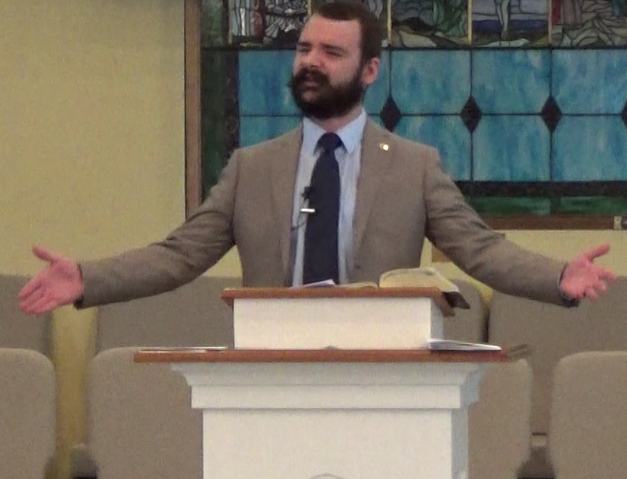
The following sermon was delivered at Locust Grove Baptist Church in Murray, Kentucky, on the 29th day of April 2018, during the morning service:


profile pic5Brandon is the founder and main contributor to Brandon’s Desk, the blog with biblical resources from his ministry. He is proud to be the pastor of the family of believers at Locust Grove Baptist Church in Murray, Kentucky. He and his wife Dakota live there with their two dogs, Susie and Aries.

Review: The End of Secularism by Hunter Baker

Freedom from God is desirable only by those who wish for their own destruction. In fact, the desire for this freedom is what caused humanity to plunge into sin and deathโ€”so there is no reason to pursue it. But somehow, freedom from God in the political realm is the greatest pursuit. A society which is free from God and religion is the highest and inevitable goal of human societyโ€”and that is the heartbeat of secularism. According to secularism, human society flourishes when it is free of both God and religion so that we can focus on our fundamental interests, which we all supposedly have in common. History demonstrates that religion has resulted in only demise for human societyโ€”wars, division, and strife. Therefore, politics and the public square shouldnโ€™t be guided by superstition or the supernatural. Moreover, as the human species progresses in knowledge and rationality, there simply is no need for religion anymore.

By observation of our surroundings, it would appear that secularism is indeed our inevitable destiny as a society, given its dominance in our government and among our institutions, colleges, and culture. But quite franklyโ€”nothing could be further from the truth. Nothing more than a second glance at secularism is required to reveal that such an idea is far from the best option for a flourishing human society. Secularism is simply not the answer to the question of how we can function in society with so much pluralityโ€”and thatโ€™s what Hunter Baker establishes in The End of Secularism. Baker succinctly demonstrates that secularism offers no such neutral ground which it claims, and it is not something into which society must unavoidably drift. Instead, it is merely a disproportionate reaction to the numerous calamities resulting from church-state alliances in Western history.

Baker reveals that secularism fails to accomplish what it was designed to doโ€”create and sustain social harmony without religion. Instead, the way to have social harmony is by valuing a public square that welcomes all voices into the discussions surrounding the interests of society. That is the only way to preserve free speech, religious freedom, and a democratic society. The title of the book is very fitting, for Baker explains the end goal of secularism and the end of it, because it is a poor idea coming to its death.

Summary of the Book

Baker accomplishes his goal in two major parts: history and rebuttal. In the first portion of the book, spanning chapters 1-8, he walks quickly through the development of secularism in Western history. Baker demonstrates through historical events and key figures that there has been a struggle for power between the church and the state, and how various solutions have been proposed for how to maintain balance between the two. In the second portion of the book, from chapter 7 to the end, he offers a reasoned rebuke of secularism as supposedly the best answer to this struggle. He evaluates and analyzes the results of the happenings of history and applies that assessment to Americaโ€™s founding and current situation. The most powerful part of the rebuke comes in chapter 10 on through to the conclusion of the book, where he explains that secularism utterly fails to accomplish peace in human society.

Personal Impact

Prior to reading this book, I had not realized how much secularism dominates in the public square. It appears that any view which even smells of the Christian religion is marginal, while secularism is regarded as not only normal but noble. Separation of church and state has been misinterpreted as a comprehensive privatization of religion, and Baker powerfully demonstrates this in a way I had never realized before. I come away from the book with a new perspective on both secularism and religion.

A Few Issues

Although this book is probably the best on the subject, there are several things that could have made the book even better, in my opinion. First (and this may be a matter of opinion), Baker takes too long to get to the main point of the book. Obviously, the history in the first portion of the book makes a powerful and necessary point. But the book would have read much better had he woven the failures of secularism through the journey of history he explained. The beginning of the book starts by explaining some of secularismโ€™s failures, but that is seemingly dropped until the second portion of the book. In the history section, there are hints here and there of secularismโ€™s detrimental goals, but it isnโ€™t as clear as it could have been. The meat of the book in the second portion was like eating a delicious supper youโ€™ve been waiting for hours on. I feel like he could have at least given appetizers in the first half of the book.

Secondly, there appears to be no clear solution offered for how we can move forward with all of this information. Itโ€™s possible that this is not even part of the purpose of the bookโ€”but it would have made it better. The last page of the book (194) is the clearest explanation of what we should do regarding secularism:

โ€œPluralism is better than secularism because it is not artificial. In a pluralistic environment, we simply enter the public square and say who we are and what we believe. We make arguments that advert to religion or other sources of values, and they are more or less convincing on a case-by-case basis . . . In order to preserve our freedom to talk about him [God] in all that we do, even in politics, we need only respect others by seeking to persuade rather than to coerce. Surely that is preferable to replacing the organic heart of our civilization which a mechanical one.โ€

This is very general, howeverโ€”a detailed plan would have been better. I donโ€™t feel like there is sufficient application of the ideas presented in the book.

You Still Need This Book

Although there are a few shortcomings in this book, its strengths far outweigh its weaknesses. The book is a much-needed rebuke of secularism. Christians who fear vocalizing their ideas in the public square should be emboldened by Bakerโ€™s unmatched work. He is the best person to write such a pieceโ€”he has been on both sidesโ€”once a secularist himself. And his penetrating words are timelyโ€”written in 2009 but written as though Baker could see into the future as our culture has become increasingly secularized.