
Bro. John Baker – Pastor, Mentor, and Friend

“He never said it would be easy. He did say it would be worth it.”

That was one of Bro. John’s many idioms and I never forgot it. He maintained a biblical perspective no matter his personal pain or ministry hardships. And anytime difficulty arises in my life, I hear him say it.

But far more than his words of wisdom, I remember the life he lived. He was the most biblical, godly, and sacrificial pastor I have ever known. When I sift through the memories I have of him, I constantly think of Paul’s words in 1 Corinthians 9:22, “I have become all things to all people, that by all means I might save some.” Bro. John was truly all things to all people. He made a memorable impact on everyone he knew and he certainly made an impact on me.

His influence on me began in high school. He was my bus driver during my final years at Ballard Memorial High School. In no time, we were having daily conversations on the bus about preaching and the Bible. He sacrificed precious time befriending me and he did so because that’s just the kind of person he was.

Then came the invitation to preach at his church, Ohio Valley Baptist, which would become my place of ministry for five years. They were hosting a large youth rally and he graciously invited me to preach—at 17 years of age, with no formal theological training, and little pulpit experience. But he trusted the Lord and he believed in me.

A few months later, my relationship with Bro. John deepened as I accepted the call to be the minister of youth at Ohio Valley. He poured into me in ways that have made an eternal impact. His influence and leadership are the reason I’m in the ministry today. Every day, I aspire to be the kind of pastor and Christian that he was. In our relationship, he faithfully applied 2 Timothy 2:2, “And what you have heard from me in the presence of many witnesses entrust to faithful men, who will be able to teach others also.” Throughout the entirety of my time serving in ministry with him, he mentored me for pastoral ministry.
snapshot-1-12-2-2012-8-23-am.png

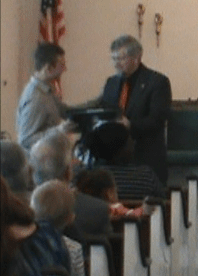
I’ll never forget the day he shook my hand and presented me with my license to preach. I preached a bummer sermon that morning, but he knew the Lord had called me to preach and on November 25, 2012 he and Ohio Valley confirmed so by licensing me to preach the gospel. He also conducted my ordination on December 15, 2013 and I’ll never forget what he said: “I’m gonna tell you what the apostle Paul told Timothy and how I believe he said it: PREACH. THE. WORD!”

They say faithfulness in ministry is both taught and caught. That is, you learn to be a faithful pastor through instruction, example, and experience. He provided me with the right combination of all three. He wisely counseled me in matters of life and ministry, but he simultaneously provided the best example for me to follow and gave me plenty of opportunities to serve the Lord (and even make mistakes).

318311_4771256193513_2126824425_nI remember vividly when he taught me how to baptize new believers. He insisted that I join him in the baptistery to watch and learn. He even assisted me as I baptized one of my best friends. He knew I needed the experience for when I would become the pastor of my own church.

Snapshot 2 (2-4-2013 9-47 AM)

Bro. John is also the reason I went to Bible college. After graduating high school, I didn’t want to do anymore schooling. But he continued to encourage me to pursue some kind of formal theological training. Recently, I graduated from Boyce College with an Associates of Arts in Biblical and Theological Studies. I just received my diploma in the mail and I wish I could have shown it to him and expressed my deepest gratitude for his encouraging me to pursue it (I have a feeling he knows now).

414627_4004776351996_1691435617_oHe was a man who “walked slowly through the people.” That is, he made a real effort to spend time with people. He would listen to you—not just to reply, but to show that he loved you. He was the most relational pastor that I’ve ever known. He was there anytime he was needed. He was at every event. He had fun during church events and always made them more lively.

I remember the times he rushed to the hospital to visit people in need. Many of those times, he brought me with him. Whether it was a routine surgery, a sudden illness, or a tragic death—he was there to love and lead people who were hurting. He taught me that a pastor ought to be seen outside the church as much as inside the church. 

1223121212And he always did more than what was required of him. He was a faithful pastor who always exceeded his job description. Even before he came to Ohio Valley, I am told that he got on his rubber boots and helped one of the families move things out of their house before it flooded. When there was something that needed to be done, he did it—no matter how mundane. In fact, another idiom of his was, “Sometimes if it’s not done by the pastor, it won’t get done.” 

622411_3910863644237_1265532537_oBro. John also exemplified Paul’s command to always be ready to preach (2 Tim. 4:2). Everywhere was his pulpit. He preached outdoors on the church lawn and at the public parks. He preached at weddings and funerals. He even preached to the folks down at the nursing home. He was always ready. No matter how busy he was, he was always prepared to open and explain the word of God.

29340171_10213256988073434_4290167721586327552_o

He was also instrumental in the relationship that me and my wife share. We both distinctly remember how he tenderly counseled us as we prepared for marriage. When the wedding day arrived, she and I were shaking like leaves on a tree, but he was calm and composed—which really helped ease our tensions. 

Words can never express how much he means to me. There is so much more that I want to say. But all in all, Bro. John taught me how to be a faithful pastor, a devoted Christian, and a loving husband. I’m going to miss his wise counsel and quirks. I am going to miss calling him on the phone for advice regarding issues in ministry. But I am anticipating the day when we will be reunited in glory.

I love you, Bro. John. You did so much for me that you didn’t have to do. I am who I am today because you befriended and mentored the young man on your school bus.

This slideshow requires JavaScript.

Day 3: A Savior Better Than Santa

“And in the same region there were shepherds out in the field, keeping watch over their flock by night. And an angel of the Lord appeared to them.” —Luke 2:8-9a

Santa is not very inclusive—he only brings gifts for good boys and girls. He even puts you on the naughty list if you’ve been behaving badly. Those who receive presents from Santa are children most qualified to receive them. The Lord Jesus, by contrast, gives the greatest gift to those who are the least qualified to receive it. He came to earth to grant eternal life to undeserving sinners.

The mission of Christ to save the least likely people is seen in the fact that shepherds were the first to hear the good news of His coming. The advent of Jesus was not announced to kings or emperors, but to some of the most insignificant persons in Judean society. Although shepherds were important, the culture viewed them as minuscule. In fact, they couldn’t even testify in court. Yet, an angel of the Lord appeared to them and they became the first recipients of the news that the Savior had been born.

The Gospels reinforce the idea that He cares for the low-ranking people of the world. The first disciples were fishermen. The kind of people He healed were lepers, paralytics, and those possessed by demons. He ate with tax collectors and sinners. He cared for widows and the sexually immoral. Jesus came for the least qualified—as He Himself said, “I have not come to call the righteous, but sinners to repentance” (Luke 5:32).

The good news of Jesus is for you, too. You don’t have to be outstandingly qualified to receive His gift of eternal life. The Lord Jesus will grant salvation to you, no matter who you are or what you have done. By repentance and faith (Acts 17:30; Eph. 2:8-9), eternal life can be yours even if you are sexually immoral, idolatrous, adulterous, greedy, or addicted (1 Cor. 6:9-11). Jesus is a significant Savior who came for insignificant people—that’s another reason why Jesus is better than Santa.


profile pic5Brandon is the founder and main contributor to Brandon’s Desk, the blog with biblical resources from his ministry. He is proud to be the pastor of the family of believers at Locust Grove Baptist Church in Murray, Kentucky. He and his wife Dakota live there with their three dogs, Susie, Aries, and Dot.

Day 2: Extraordinary in the Ordinary

“In those days a decree went out from Caesar Augustus that all the world should be registered . . . And all went to be registered, each to his own town.” —Luke 2:1, 3

There is nothing unusual about filing and paying taxes, except when you receive a generous refund. Likewise, paying taxes in New Testament times was completely normal. Luke explains that it was tax time for the Jews as Caesar issued a decree for the purpose of assessing taxes. This was business as usual. Nothing out of the ordinary was occurring—or so it seemed.

Amazingly, this decree is what God used to bring Joseph and Mary to the prophesied birthplace of the Messiah. The prophet Micah foretold that the Christ would be born in Bethlehem:

“But you, O Bethlehem Ephrathah, who are too little to be among the clans of Judah, from you shall come forth for me one who is to be ruler in Israel, whose coming forth is from of old, from ancient days (Micah 5:2).

There’s just one problem—Mary was not in Bethlehem (Luke 2:4). Thankfully, this taxation would take them there because, in order to comply, every Jew had to travel back to their hometown. For Joseph, this was Bethlehem, the city of David. Luke says that Mary and Joseph proceeded to Bethlehem (v. 4) and it is there that Mary, “gave birth to her firstborn son and wrapped him in swaddling cloths” (v. 7).

God sovereignly moved in the heart of Caesar (Prov. 21:1) to fulfill His word concerning Jesus. The Sovereign Lord of the universe used an ordinary taxation for an extraordinary purpose. Even today, God uses ordinary people and events for extraordinary purposes. God didn’t create the world and then abandon it—He is actively involved in the creation at each moment to accomplish His sovereign will. He will use whatever it takes to fulfill His perfect plan—even things that are completely normal.

Right now, God is active in the ordinary things of your life—the day-to-day happenings that appear humdrum. As John Piper has said, “God is always doing 10,000 things in your life, and you may be aware of three of them.”[1] So, take heart if you have an ordinary life because God used a standard taxation to bring Jesus Christ into the world. Who knows what He will do through the ordinary things in your life? To be sure, whatever He does is always for your good and His glory (Gen. 50:20; Rom. 8:28; 11:36).


profile pic5Brandon is the founder and main contributor to Brandon’s Desk, the blog with biblical resources from his ministry. He is proud to be the pastor of the family of believers at Locust Grove Baptist Church in Murray, Kentucky. He and his wife Dakota live there with their three dogs, Susie, Aries, and Dot.


[1] https://www.desiringgod.org/articles/god-is-always-doing-10000-things-in-your-life

Day 1: When Heaven Had Christmas

“And suddenly there was with the angel a multitude of the heavenly host praising God.” —Luke 2:13a

Christmas is the biggest celebration of the year with its own decorations, symbols, music, traditions, foods, and even colors. However, because some elements of this season have their roots in ancient pagan festivals, many do not celebrate Christmas. And while it is true that many Christmas practices began in paganism, the pagan meanings were lost long ago. Besides, Christians through the centuries have celebrated Christmas and we have consistently out-celebrated the pagans. This is because the birth of Christ is worth celebrating.

In fact, heaven itself celebrated Christmas—heaven erupted in acclamation and praise when Jesus was born. One angel made the announcement that Christ had come (Luke 2:9-12), but he was immediately joined by thousands of others. As Luke says, a multitude of the heavenly host suddenly appeared and accompanied the angel with exuberant praise to God. The angels in heaven were so thrilled at the arrival of the Messiah that they came alongside the one angel in glorifying God for the good news. Someone once said, “Heaven’s choir came down to sing when heaven’s King came down to save.”

The angels in heaven saw the first advent of Jesus as reason for rejoicing, gladness, and cheer. Do you see it that way? If Christ’s coming was celebrated in heaven, why wouldn’t you celebrate it on earth? Christmas is worth celebrating because Jesus is worth celebrating. John Wesley’s hymn, Hark! The Herald Angels Sing invites you to joyfully celebrate with the heavenly host:

“Joyful, all ye nations rise,
Join the triumph of the skies;
With angelic host proclaim,
“Christ is born in Bethlehem!”
Hark! the herald angels sing,
“Glory to the new-born King!”


profile pic5Brandon is the founder and main contributor to Brandon’s Desk, the blog with biblical resources from his ministry. He is proud to be the pastor of the family of believers at Locust Grove Baptist Church in Murray, Kentucky. He and his wife Dakota live there with their three dogs, Susie, Aries, and Dot.

A Guide for Thanksgiving

As we prepare for Thanksgiving, it’s important to remember the history of this holiday. The first Thanksgiving in America was celebrated among the Pilgrims and the Wampanoag Indians in 1621. Over a century later, President George Washington proclaimed Thursday, the 26th of November 1789, a day of public thanksgiving and prayer. However, Thanksgiving became an official federal holiday when President Lincoln declared it as such during the Civil War, 156 years ago. Thanksgiving is rich with American history.

And while nothing is more American than abandoning our diets and fighting each other over discounts the day after we remember what we’re thankful for, Thanksgiving is not exclusively American. The Bible tells us that the Israelites celebrated their own “thanksgiving” nearly 3,000 years ago, and it was much more than a holiday—it was an act of worship.

Three millennia ago, Psalm 100 was written as a guide for the Jews as they gave thanks and expressed gratitude for their blessings, much like we do at Thanksgiving. It is, as the superscript of the psalm says, “A Psalm for giving thanks.” It provides guidance and instruction regarding thanksgiving. And as Thanksgiving approaches, you can use this psalm as a manual for how to give thanks to the Lord.

Psalm 100 tells us four things about thanksgiving:

(1) Giving thanks can be done through song. In the first two verses, it says, “Make a joyful noise to the LORD, all the earth! Serve the LORD with gladness! Come into his presence with singing!” Singing is essential to giving thanks (Acts 16:25; Eph. 5:19; Col. 3:16; James 5:13). Sing a song to the Lord as an expression of your gratitude for who He is and what He has done.

(2) Giving thanks is personal. The psalm continues, “Know that the LORD, he is God! It is he who made us, and we are his; we are his people, and the sheep of his pasture” (v. 3). In order to give thanks to God, you must have a personal relationship with Him—you must know Him as Lord. You must be among His people—a sheep in His pasture.

(3) Giving thanks should be corporate: “Enter his gates with thanksgiving, and his courts with praise! Give thanks to him; bless his name!” (v. 4). You cannot fully give thanks to God unless you are in the presence of other believers. Thanksgiving happens in His “courts” and “gates.”

(4) Giving thanks should be done because of God: “For the LORD is good; his steadfast love endures forever; and his faithfulness to all generations” (v. 5). You are to give thanks because God is good, loving, and faithful.

Let Psalm 100 guide you this week—honor the history of Thanksgiving by honoring the Lord with your thanksgiving.


profile pic5Brandon is the founder and main contributor to Brandon’s Desk, the blog with biblical resources from his ministry. He is proud to be the pastor of the family of believers at Locust Grove Baptist Church in Murray, Kentucky. He and his wife Dakota live there with their three dogs, Susie, Aries, and Dot.

The Roaring Lion

There are thousands of good ideas in the world—entering into a lion enclosure at the zoo is not one of them. Earlier this year, a man miraculously survived a lion attack after doing just that. An employee at the Serengeti Zoo in Hamburg, Germany, entered into the enclosure to do a routine fence check. Usually, the lions are in their cages when employees enter, but not this time. One of the lions pounced and attacked the man and he sustained several serious injuries as a result. Needless to say, lions are dangerous whether they are in the wild or in zoos. They are territorial and always ready to fight anything that may challenge them. Not to mention, they are natural hunters that can reach speeds of up to 50 miles per hour.

Another bad idea is walking around as a Christian, unaware of the fact that a more dangerous lion lurks around, waiting to chow down on your life. In 1 Peter 5:8, Peter gave a firm warning about this lion: “Be sober-minded; be watchful. Your adversary the devil prowls around like a roaring lion, seeking someone to devour.” Peter says that Satan wants to devour and destroy you, just like a roaring and hungry lion.

Comparing the devil to a lion suggests at least four things about his nature and work. First, the devil wants to consume you just as lions consume their prey. Lions hunt by staying hidden so their prey will be inattentive to their presence. Once they get close enough to the unsuspecting animal, they chase them until they are caught. This is precisely what the devil does to believers. The devil is always hidden, disguised as an angel of light (2 Cor. 11:14). And he will attack when you are ignorant of his presence.

Second, like a lion, the devil attacks the weak. Lions don’t normally hunt elephants or giraffes because they are too challenging to kill—they are much larger than lions. Instead, lions will stalk smaller and weaker animals—antelopes, zebras, or wild hogs. Likewise, the devil hunts the spiritually weak. The devil will tear you apart when you are frail and defenseless without your spiritual armor (Eph. 6:10-20).

Third, the devil intimidates just as lions do. Lions roar to show how big they are—to scare their prey and competitors. The devil also roars to instill fear and he does so through persecution, fierce trials, and strong temptations.

Finally, the devil devours just as lions devour their prey. Lions don’t eat with silverware and neither does the devil. Like a lion, the devil wants to consume you until there is nothing left and he will leave a mess.

The best idea is to be sober-minded and watchful, alert and prepared to fight when he attacks.


profile pic5Brandon is the founder and main contributor to Brandon’s Desk, the blog with biblical resources from his ministry. He is proud to be the pastor of the family of believers at Locust Grove Baptist Church in Murray, Kentucky. He and his wife Dakota live there with their three dogs, Susie, Aries, and Dot.

Hungry Christians

The following column was published in the Murray Ledger & Times, Weekend Edition November 9-10, 2019:

Hungry Christians

Bible Gleanings by Brandon Bramlett

Pastor of Locust Grove Baptist Church

All babies cry. Their cry is one heard ‘round the world, too. One, because all babies everywhere cry, no matter their skin color or ethnicity. Their squeal requires no translation—every language understands it. And two, some cry so loudly that it appears to travel the globe. A variety of things may cause an infant to cry. Perhaps they need a diaper change. Maybe they want to be held. It may be that they are trying to break a world record for the loudest and longest cry. But every parent knows that infants often cry when they are hungry. It’s their way of saying, “Hey, I’m hungry—feed me.” It is healthy for a baby to be hungry—they need nourishment to be strong, growing, and healthy.

If you are a Christian, so do you. You need spiritual food so you can thrive, flourish, and grow. It is healthy to be spiritually hungry for spiritual nourishment. No wonder the apostle Peter wrote, “Like newborn infants, long for the pure spiritual milk, that by it you may grow up into salvation” (1 Peter 2:2). Just as newborns naturally hunger for the nutrition that comes from their mother’s milk, it should be natural for you to hunger for the nutrition that comes from God. More specifically, this spiritual nutrition comes from, “the pure spiritual milk.” Clearly, this is referring to the word of God in the Old and New Testaments. The Scripture is pure—undefiled, free of contamination and error. The Scripture is spiritual—it deals with our spiritual lives. And the Scripture is like milk because we can digest it and be nourished by its contents.

As a believer, you are commanded to hunger and cry out for the word of God so you will feast upon it and “grow up into salvation.” The more you hunger for the word and are fed by it, the more you’ll grow in your salvation. This intense desire for the word of God has been characteristic of believers since the time of Job. Job described his intense longing for the Bible like this: “I have not departed from the commandment of his lips; I have treasured the words of his mouth more than my portion of food” (Job 23:12).

But how can you maintain a hunger like this? Here’s the answer: understand that hunger is directly correlated to taste. Think about your favorite meal—you hunger for it because you know how good it tastes. Likewise, you will hunger for the word of God the more you taste it. Many have no desire for the word because they don’t know what it tastes like. But the more “meals” of God’s word you consume, the hungrier you’ll be, and the more you’ll grow. So, are you a hungry Christian?

6 Reasons for Preaching Christ

No one can say it like Charles Spurgeon. During one of his sermons, he expressed great astonishment at preachers whose sermons were not centered on Christ. And he gave this stunning exhortation: “No Christ in your sermon, sir? Then go home, and never preach again until you have something worth preaching.”

Jesus is worthy to be preached. Christ should be clearly and powerfully proclaimed in our sermons, brethren. If He is not, our sermons simply aren’t worth preaching. We who preach Sunday after Sunday (should) recognize the importance of preaching Christ. In our expositions, there should always be a connection with the person of Christ, the teaching of Christ, or the work of Christ. But why should we preach Christ in the first place? Why should pastors make effort to preach Christ in their sermons?

In his monumental work, Preaching Christ from the Old Testament, Sidney Greidanus gives us six reasons for preaching Christ.¹ Here they are:

1. Preach Christ Because the Apostles Did

The New Testament gives us dozens of instances where Peter, Paul, and the other apostles powerfully and consistently preached Christ. In fact, the book of Acts records that every sermon they preached was always centered on Jesus. Jesus was the shining light in their message, whether it was Peter’s sermon at Pentecost, Stephen’s sermon to the Sanhedrin, or the numerous sermons preached by Paul. Greidanus explains, “The heart of apostolic preaching is Jesus Christ . . . The New Testament church preached the birth, ministry, death, resurrection, and exaltation of Jesus of Nazareth as the fulfillment of God’s old covenant promises, His presence today in the Spirit, and His imminent return.” We need to follow the example of the apostles and preach Christ in our sermons. The reason we may not have the results the apostles did when they preached is that we do not model our preaching after them.

2. Preach Christ Because Jesus Commanded It

Every believer knows the chief mission of the church is to make disciples who will follow Christ in obedience. Jesus commands us, “All authority in heaven and on earth has been given to me. Go therefore and make disciples of all nations, baptizing them in the name of the Father and of the Son and of the Holy Spirit, teaching them to observe all that I have commanded you. And behold, I am with you always, to the end of the age” (Matt. 28:18-20). There is a lot to say about this passage, but one thing to notice is that every component of the Great Commission is centered on Christ. Disciples of Christ are to be made. They are to be taught to observe all that Jesus commanded. And the presence of Jesus will be with us as we do.

Disciples will be produced when we teach people to observe all that Jesus promised, warned, taught, and commanded. Just like the disciples of Jesus’ day, we are commanded by our Lord to preach Him today. His command is an enduring one and nothing has changed about the mission of the church since the day Christ uttered these words. Greidanus comments, “Christian preachers today also live under the command to preach the name of Jesus Christ, for the command to preach Christ reaches far beyond the first apostles and Gospel writers – it reaches ‘to the end of the age.'”

3. Preach Christ Because It Is Exciting

What could be more exciting than preaching Christ? What Christ accomplished for His people is the greatest thing in history. It is only logical to preach Christ because of the nature of the message. I love how Greidanus put it: “Even today when a President or a Queen visits a city, the arrival itself is a newsworthy event. No one needs to command broadcasters to tell the story, for the story itself begs to be told. If this is true for the arrival of a President or a Queen, how much more for the arrival of ‘the King of Kings.'” Yes! We need to preach the story of Christ because it has to be told.

4. Preach Christ Because It Is Life-Giving

We need to preach Christ because of what God does when we do. God saves people through the hearing and preaching of the gospel (Rom. 10:14-17; Eph. 1:13). Our sinful world is spiritually dead, cut off from God, and headed for an eternity in hell. The message of Jesus Christ gives people spiritual life, reconciles them to God, and guarantees a new eternal destination. Because of the life-giving nature of preaching Christ, we are compelled to preach Christ. Woe unto us if we don’t preach Christ (1 Cor. 9:16)! Greidanus powerfully illustrates this point: “When there was an outbreak of polio in British Columbia, Canada, in the 1970s, the government wasted no time getting out the message to all parents to have their children inoculated against polio. It was a vital message; it needed to be broadcast immediately. The need to tell was obvious in the light of the disease and the availability of an antidote. [In the same way] People need to be told about the cure [the gospel].”

5. Preach Christ Because It Is Exclusive News

The need to preach Christ is also seen in the exclusive nature of the message. We need to preach Christ because, “There is salvation in no one else, for there is no other name under heaven given among men by which we must be saved” (Acts 4:12). There is no other message available which saves people from their sins. There are not “many ways to God,” and if there were, preaching Christ would be no big deal. It would just be one path among many. But the Bible teaches that Christ is the only path – the only way to God (John 14:6). Therefore, Greidanus says, “If Jesus were one of many ways of salvation, the church could relax a bit, hoping that people might find some other way to be saved from death. But now that Christ is the only way, the urgency of preaching Christ is all the more pressing. There is salvation in no one else but Jesus.”

6. Preach Christ Because Our Culture Is Anti-Christ

Finally, we need to preach Christ because we live in a non-Christian culture. As our culture continues to move on from Judeo-Christian values, the need for preaching Christ continues to increase. This culture shift unfortunately affects both believers and unbelievers. We cannot assume that believers know Jesus as we think they do, or that unbelievers know that the Jesus we worship is the Bible’s Jesus. More than any other time in history, our culture is in desperate need of preaching Christ. Greidanus observes, “The early church, in the nature of the case, addressed people living in a non-Christian culture. People needed to hear about Christ and the difference he makes. But contemporary preachers equally address people living in a non-Christian or post-Christian culture. If contemporary hearers were living in a culture saturated with Christian thinking and action, one might perhaps take for granted that people hearing a sermon would sense how it is related to Christ.” But we cannot, and therefore should not, assume this.


  1. Greidanus, Sidney. Preaching Christ from the Old Testament (Grand Rapids: Wm. B. Eerdmans, 1999), 10-14.

profile pic5Brandon is the founder and main contributor to Brandon’s Desk, the blog with biblical resources from his ministry. He is proud to be the pastor of the family of believers at Locust Grove Baptist Church in Murray, Kentucky. He and his wife Dakota live there with their two dogs, Susie and Aries.

The Persecuted Church (Rev. 2:8-11)

The following sermon was delivered at Locust Grove Baptist Church in Murray, Kentucky, on the 5th day of May 2018, during the morning service:


profile pic5Brandon is the founder and main contributor to Brandon’s Desk, the blog with biblical resources from his ministry. He is proud to be the pastor of the family of believers at Locust Grove Baptist Church in Murray, Kentucky. He and his wife Dakota live there with their two dogs, Susie and Aries.

Resources from the Ministry of Pastor Brandon G. Bramlett