The following sermon was delivered at Locust Grove Baptist Church in Murray, Kentucky, on the 15th day of October 2017:
“23 For I received from the Lord what I also delivered to you, that the Lord Jesus on the night when he was betrayed took bread, 24 and when he had given thanks, he broke it, and said, “This is my body, which is for you. Do this in remembrance of me.” 25 In the same way also he took the cup, after supper, saying, “This cup is the new covenant in my blood. Do this, as often as you drink it, in remembrance of me.” 26 For as often as you eat this bread and drink the cup, you proclaim the Lord’s death until he comes” (1 Corinthians 11:23-26).
Gathered Together for Remembrance
Jesus died. Could you think of a more stunning and sobering truth? That truth is a feature which is exclusive to the Christian faith – it sets us apart from all other religions which exist. Enough good works and you might please God or gods, according to all religions. But in the Christian faith, God takes on human flesh and dies, to enable you to please Him forever! This stunning and sobering truth that Jesus died is precisely why we have gathered together to observe what is known as the Lord’s Supper. We who know the Lord are gathered together here this morning for what is truly a special and solemn occasion, and that is to observe the Lord’s Supper. For that reason, I will not preach for very long this morning, because the Lord’s Supper itself is an unwritten sermon—what it means and what it represents is just as much a proclamation of the truth, as is my speaking of it to you.
The Lord’s Supper is certainly a wondrous thing—it is an ordinance which Jesus Himself instituted to remind us of Him. And how many of us know we could be more reminded of Jesus every day, amen? It is a physical representation which reminds us of the gospel—that Jesus died for sinners so that we who believe can be saved and have supper with Him again one day in glory. We need to be reminded of this truth constantly—we are forgetful people by nature, we forget things all the time. I bet none of us can recall what we saw on the news Friday night, or what we read on Facebook yesterday, or even what we read in our Bibles on Tuesday. Our minds fill up with knowledge, and our minds deteriorate—and both are reasons we forget.
But let me tell you this morning—I’m glad the Lord Jesus Christ knows we forget. The Lord knows we forget, and the Lord saw fit to remind us of the truth of the gospel through the Lord’s Supper. We need the Lord’s Supper to remind us of the greatest truth in all the world, that Jesus came to seek and save that which was lost. This morning, we will look at what God’s word says about the Lord’s Supper—that would be the best place to begin. And we will spend our time this morning understanding the meaning of the Lord’s Supper, before we partake of it. And that is the most important part of the Lord’s Supper—understanding what it means and what it represents. We must understand the meaning of the memorial. We need to know what the Lord’s Supper means, and understand it’s significance. If we don’t know what we’re doing when we’re doing it, then there’s no point.
We can discover the meaning of the Lord’s Supper by looking at 1 Corinthians 11, where Paul explains exactly what it is. This is yet another thing the Corinthians got wrong. They were abusing the Lord’s Supper, misapplying and misunderstanding its meaning. In fact, they had it so messed up that Paul said that when they came together for worship, they might as well have stayed home. He says in v. 17, “But in the following instruction I do not commend you, because when you come together it is not for the better but for the worse” (11:17). And so, in the latter half of chapter 11, Paul is correcting them and giving instructions pertaining to the Lord’s Supper. We will see this morning that apparently, they completely misapplied and misunderstood the significant meaning of the Lord’s Supper, and that’s what lead to all of their problems surrounding it. The reason they were mistreating people, the reason why they were gluttonous, the reason why they were casual in their approach to this supper, even the reason why they were divided—it was all due to their malpractice and misunderstanding of the Lord’s Supper.
The Corinthians needed to understand the meaning of the Lord’s Supper, that it is both a remembrance and proclamation of the gospel. And we need to understand this today. We as believers today need to understand the meaning of the Lord’s Supper, that it is both a remembrance and proclamation of the gospel. It is not some liturgical ritual, or even a casual element tacked on at the end of a church service. It is a sermon, a memorial, a reminder, and a remembrance and proclamation of the gospel!
We will see in the passage we read this morning that:
I. The Lord’s Supper is the Tradition of Christ (v. 23a)
II. The Lord’s Supper is Remembering the Body of Christ (vv. 23b-24)
III. The Lord’s Supper is Remembering the Blood of Christ (v. 25)
IV. The Lord’s Supper is Proclaiming the Gospel of Christ (v. 26)
Let us now begin in Paul’s letter to the Corinthians, the 11th chapter.
I. The Lord’s Supper is the Tradition of Christ (v. 23a)
The first thing that will help us understand the meaning of the Lord’s Supper is understanding where it came from. It isn’t a concoction produced by the Roman Catholic Church, and it isn’t the product of any Protestant denomination—in fact, no denomination, no religion, and no person but Jesus Christ Himself is responsible for instituting the Lord’s Supper. If any man came up with it, it wouldn’t hold any real value and it wouldn’t be worthy of practicing in the church today.
The name of this ordinance is very fitting—the Lord’s Supper, because it is just that—it is the supper which the Lord Himself instituted. And that’s the first thing we see in the passage regarding the Lord’s Supper—it is the tradition of Christ. That is precisely why we remember the Lord’s Supper—it has been instituted and commanded by our Lord Himself. And obeying His command to observe it is just as important as obeying any of the other commands which He has given us.
So in the first verse, Paul is reminding the Corinthians that the Lord’s Supper is the tradition of Christ—it is something Paul first received from the Lord to teach to the Corinthians. It is not Paul’s Supper, the Corinthians’ Supper—but the Lord’s Supper.
First, this is a tradition which Paul received from the Lord. Before reminding them of the meaning of the Lord’s Supper, he first establishes its authenticity and therefore his authority in instructing them on how to do it. Paul is explaining the origin of the Lord’s Supper. That’s where Paul goes first, because if the Corinthians know where the Lord’s Supper comes from, it will greatly affect how they see it, and it bears an even greater responsibility for understanding and applying it correctly. If they mess it up, they sin against the Lord, since it is His supper. If it is a tradition of Christ – if it comes ultimately from God, then it is serious.
Paul says that this tradition is something which he received from the Lord in the first part of v. 23, “For I received from the Lord what I also delivered to you.” This tradition should be observed because it comes from the Lord, and Paul’s instructions should be heeded because they too come from the Lord. This is a tradition which Paul first received from the Lord. But it wasn’t something he kept to himself, he also shared it with the Corinthians.
That’s what Paul says next. Notice secondly that he delivered this tradition to the Corinthians. “For I received from the Lord what I also delivered to you.” Notice the tense of the word delivered—it’s in the past tense, meaning that sometime previously Paul had instructed the Corinthians concerning the Lord’s Supper. They already knew about it—they had been instructed about it before when Paul delivered it to them. It was first delivered to Paul by the Lord and then Paul delivered it to the Corinthians. This is a tradition they knew about and regularly practiced, because Paul taught them all about it before. They weren’t ignorant about it, they practiced it every time they “came together” (v. 20).
But even though the Corinthians were once taught about the Lord’s Supper, authoritatively from the apostle Paul—they continued to abuse and misunderstand it. That just shows you that a church can have a great pastor, and still be a bad church! And I hope you comprehend this morning that the only thing separating us today from the Corinthians is time and distance. We too can just as easily be taught authoritative instructions about the Lord’s Supper from Scripture, and continue to misunderstand it, undervalue it, abuse it, or approach it flippantly like it’s yesterday’s coffee. No Christian is immune from misunderstanding the Lord’s Supper, or this passage of Scripture under consideration would not need to be written! Just because you’ve been taught correctly about the Lord’s Supper for years does not guarantee you will truly understand and appreciate its gospel-meaning.
And frequency of observance doesn’t ensure understanding and appreciating its meaning either. You can observe the Lord’s Supper for 65 years and be as far from its meaning as the east is from the west. Traveling to the place where you can understand its meaning begins here with understanding that it is the tradition of Christ—it is something which Jesus Himself commanded and instituted.
And if the Lord’s Supper is the tradition of Christ, then that means several things. First, we dare not neglect it. If it’s something Jesus started, we should continue it. Second, we dare not approach it flippantly, because it bears His authority. It deserves the utmost respect when we observe it, if it is the tradition of the Lord. And thirdly, we should long to understand its meaning, if it is so meaningful. If it bears the authority of Christ, as tradition which He has instituted, then we should want to know what its all about!
We need to understand that the Lord’s Supper is the tradition of Christ.
II. The Lord’s Supper is Remembering the Body of Christ (vv. 23b-24)
Not only do we need to understand that it is Christ’s tradition, but secondly, we also need to understand this morning that the Lord’s Supper is remembering the body of Christ. It is a time for us to remember that Jesus gave His body for us on the cross. The Lord’s Supper is remembering the body of Christ, and it is uniquely represented by the breaking and consumption of bread. There’s a reason why bread is chosen to represent that, and we will take that up later. But in giving instruction and correction on the Lord’s Supper, Paul goes straight to the teaching of Jesus on this matter, and he refers to Jesus’ last earthly supper with His disciples where the Lord Himself instituted such an ordinance. If it is the tradition of Christ, it makes since for Paul to refer to this exact tradition, as he does here.
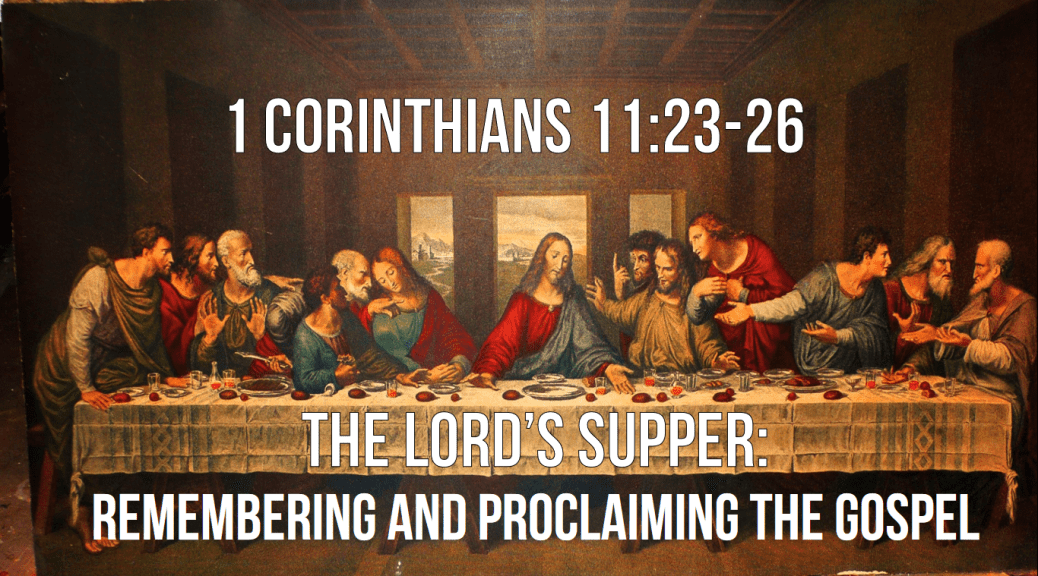
Paul recalls exactly when the institution of the Lord’s Supper took place. Paul says, “the Lord Jesus on the night he was betrayed [instituted this supper].” The institution of the Lord’s Supper took place during Jesus’ last meal on earth with His disciples before He was crucified and killed. This institution took place the night that Judas betrayed Him. Before He was betrayed, He has this memorable supper with His disciples, and Jesus institutes a new ordinance for His disciples to observe from then on. Luke tells us that “when the hour came, he reclined at table, and the apostles with him” (Luke 22:14).
Paul says that on this night he “took bread, and when he had given thanks, he broke it.” The first part of the Lord’s Supper concerns bread, that’s what we see Jesus doing here. He took bread, gave thanks for it, and likely tore it in pieces as He handed to His disciples to eat. Now, why bread? Was it because it was convenient and easy to produce? The reason for the bread was because of why they were gathered together. They were gathered together and sharing a meal because it was Passover. And the consumption of bread was commanded in partaking of the Passover. Passover, if you didn’t know, is a festival which Jews observed as a memorial of when God delivered the Israelites out of the hands of the Egyptians. In Exodus 12, we read what brought this about: God was striking the Egyptians with plagues in an effort to convince Pharaoh to let the Israelites be free from slavery. He didn’t budge, so God threatened them with one final plague—the death of the firstborn son. And the Israelites were commanded to take the blood of a spotless lamb and place it on their lintels and doorposts so that God would “pass over” their house, so their firstborns would live. Hence the name, Passover. God said, “The blood shall be a sign for you, on the houses where you are. And when I see the blood, I will pass over you, and no plague shall befall you to destroy you, when I strike the land of Egypt” (12:13). They were also commanded to have a meal during Passover as well, and God says to them that they “shall eat the flesh (of the lamb) that night, roasted on the fire; with unleavened bread and bitter herbs they shall eat it” (v. 8). And so Jesus is observing this Passover with His disciples, sharing bread with them.
But what is most striking about this scene where Jesus is sharing Passover with His disciples is how He reinterprets the Passover bread to be representative of His own body. Jesus makes no reference to the Israelites or their freedom from bondage in Egypt, but instead says concerning the bread, “This is my body, which is for you.” Jesus says that the bread is His body. Now, some like the Roman Catholic Church have taken this to mean that the bread is literally the body of Jesus, and that when you eat the bread you are literally receiving His body, and are thus saved by it. This doctrine they call transubstantiation. And while I love those who are Catholic, and have friends who are Catholic—that idea is absolute blasphemy and heresy if I’ve ever seen it. If Jesus means that the bread literally is His body, and not merely a representative of such, then we’d better take everything Jesus says metaphorically about Himself. By that logic, Jesus literally is a door (John 10:7); He literally is a vine (John 15:1), and He literally is a loaf of bread (John 6:35)!
Jesus is saying here that the bread represents His body—it represents what happened to the body. Jesus was using bread as an object lesson here, and as a fuller interpretation of the Passover supper. The bread represents His body, He says, “which was given [for us].” The bread serves as a reminder that Jesus has given Himself for us. Titus 2:14 says, “[Jesus] gave himself for us to redeem us from all lawlessness.” The bread that He gave His disciples to eat is representative of His body He was about to give for His disciples on the cross.
But that is not all Jesus says. Jesus tells the disciples that they are to “Do this in remembrance of me.” Here’s where the Lord’s Supper is enacted—Jesus issues it to us as a command. Jesus says to do this—to do what He did with the disciples at the Passover. It is Jesus saying, “This bread which I am passing on to you as representative of My body given for you on the cross— so do this same thing to remember Me.” Therein is the purpose of the Lord’s Supper—to remember Jesus on the cross. The Lord’s Supper doesn’t save you, but it does sanctify you. You do not have to observe it in order to be saved, but you certainly have to observe it if you are saved. It doesn’t justify you in the sight of God, but the justified should observe it to remember justification. The purpose of the Lord’s Supper is to remember Jesus Christ and His death on the cross—His body which was pierced on the cross. It is to remember the work of Christ on the cross, such as that which is described by Isaiah:
“Surely he has borne our griefs
and carried our sorrows;
yet we esteemed him stricken,
smitten by God, and afflicted.
But he was pierced for our transgressions;
he was crushed for our iniquities;
upon him was the chastisement that brought us peace,
and with his wounds we are healed.
All we like sheep have gone astray;
we have turned—every one—to his own way;
and the LORD has laid on him
the iniquity of us all.
He was oppressed, and he was afflicted,
yet he opened not his mouth;
like a lamb that is led to the slaughter,
and like a sheep that before its shearers is silent,
so he opened not his mouth” (53:4-7).
Are you remembering that this morning? This is a time dedicated entirely to remembering His body given on the cross. Whatever is on your mind this morning—put it to a halt and remember the given body of Jesus on the cross. The Lord’s Supper is remembering the body of Christ on the cross, as we partake of the bread together.
III. The Lord’s Supper is Remembering the Blood of Christ (v. 25)
We need to understand that the Lord’s Supper is the tradition of Christ, and that is remembering the body of Christ. But the Lord’s Supper is also remembering the blood of Christ—the new covenant ratified by Christ’s blood, and this is represented by the cup. Part of remembering what he did on the cross is remembering His spilled blood which has been spilled on our behalf, and “drank in” by faith.
Paul says, “In the same way also he took the cup, after supper.” The cup, filled with wine (or juice for most of us), is the second element in the Lord’s Supper. And Jesus says that this cup represents the new covenant in His blood, “This cup is the new covenant in my blood” (v. 25a). Often times, when speaking of the Lord’s Supper we say, “The bread represents His body, the wine represents His blood.” And there’s nothing wrong with that. But if we do not also understand that Jesus said it represents the new covenant in His blood, we lose sight of what its complete meaning is. It is not merely His physical blood, but what His blood accomplished. The blood of Jesus ensured, secured, and enabled the new covenant to be ushered in. The new covenant is what God’s people in the Old Testament looked forward to for a long time. In the days of the exodus, the Israelites entered into a covenant with God in the Old Testament. They promised to obey the Lord, and to do all He commanded – about how well do you think that worked out? Here’s the full context of what happened:
“Moses came and told the people all the words of the LORD and all the rules. And all the people answered with one voice and said, “All the words that the LORD has spoken we will do.” And Moses wrote down all the words of the LORD. He rose early in the morning and built an altar at the foot of the mountain, and twelve pillars, according to the twelve tribes of Israel. And he sent young men of the people of Israel, who offered burnt offerings and sacrificed peace offerings of oxen to the LORD. And Moses took half of the blood and put it in basins, and half of the blood he threw against the altar. Then he took the Book of the Covenant and read it in the hearing of the people. And they said, “All that the LORD has spoken we will do, and we will be obedient.” And Moses took the blood and threw it on the people and said, “Behold the blood of the covenant that the LORD has made with you in accordance with all these words” (Exodus 24:3-8).
Considering you know the Old Testament, it is easily observable that the people could not keep their end of the covenant. They constantly broke God’s laws and broke their covenant all the time. They were not obedient, and the sacrifices they were making were not enough to cover their sins completely. So the people yearned for a new covenant, where God might enable and ensure their obedience, and where He would cover their sin completely so that they would no longer need a sacrifice. The beautiful thing is that God said He would make this new covenant with them. Perhaps the greatest expression of what this new covenant will be is found in Jeremiah 31. Notice the language of salvation in this passage – the references to enabling obedience, transforming hearts, and forgiving sins:
“Behold, the days are coming [it will be in the future for God’s people], declares the LORD, when I will make a new covenant with the house of Israel and the house of Judah, not like the covenant that I made with their fathers [it will not be like the old covenant, and how it will be different is later explained in this passage] on the day when I took them by the hand to bring them out of the land of Egypt, my covenant that they broke [the precise problem with the old covenant], though I was their husband, declares the LORD. For this is the covenant that I will make with the house of Israel after those days, declares the LORD [here’s how it will be different]: I will put my law within them, and I will write it on their hearts [obedience will come from their hearts]. And I will be their God, and they shall be my people [God will be in relation with them]. And no longer shall each one teach his neighbor and each his brother, saying, ‘Know the LORD,’ for they shall all know me, from the least of them to the greatest, declares the LORD. For I will forgive their iniquity, and I will remember their sin no more [their sins will be forgiven]” (vv. 31-34).
God would transform them so that they could obey Him—He would change their hearts—that’s what happens in the new covenant. And Jesus is saying in this passage that the cup represents His work on the cross of ratifying this new covenant. It represents His blood which is the means of bringing His people into a new covenant. All those promises of Jeremiah 31 are made real through the death of Jesus Christ.
Once again, Jesus says, as He does before, to “Do this, as often as you drink it, in remembrance of me.” Like the bread, we drink the cup in obedience to Christ’s command here to remember Him. Do you notice the difference in this verse compared to the one earlier about bread? There is mention of how often you should do it. Of course, for many years, Christians have debated about how often they should observe the Lord’s Supper. Some say every time the church meets together, others say just periodically. There is great evidence for both main views, I have to confess. But the frequency of observance is not an issue which Scripture plainly and explicitly addresses – Paul and Christ just say, “as often as you do.” What matters is understanding the meaning! Those who split hairs over this need to memorize Paul’s instructions about quarrels: “But avoid foolish controversies, genealogies, dissensions, and quarrels about the law, for they are unprofitable and worthless” (Titus 3:9). The point is not how often, the point is understanding its meaning! I would rather partake of the Lord’s Supper one time a year understanding its meaning, than 52 times a year misunderstanding it!
We need to understand that the Lord’s Supper is remembering the spilled blood of Christ on our behalf.
IV. The Lord’s Supper is Proclaiming the Gospel of Christ (v. 26)
The Lord’s Supper is Jesus’ tradition. It’s remembering the body and blood of Christ, which has ratified the new covenant – these things we remember when we partake. But we also proclaim something during the Lord’s Supper. In observing it, it is proclaiming the gospel of Christ. Finally in this passage, we proclaim the gospel through the Lord’s Supper. Of course, what we have looked at already is the gospel in the giving of Jesus on the cross and of our receiving of Him by faith. But lest we entertain the thought that the Lord’s Supper is merely a ritual or a simple tradition, Paul says that it is a proclamation of the gospel as we wait on Jesus to come again. The gospel is presented through the Lord’s Supper as the elements are explained. In the Lord’s Supper, the gospel is preached as it is both seen through the eyes and heard through the ears. And that proclamation of the gospel is the very purpose of observing the Lord’s Supper. Paul says, “For as often as you eat this bread and drink the cup, you proclaim the Lord’s death until he comes.”
We testify to two truths when we partake of the Lord’s Supper—first, that He has died and been risen for us. Second, that He is coming again. Both truths are of equal importance. He died and one day He will return; He will return one day because He once died. And so we proclaim the wonderful news of the death of death in the death of Christ, but we also proclaim that He is coming again—that one day He will return to set things right, and that we will one day be with Him to feast at His table forever (Rev. 19:6-9).
Conclusion: A Reminder of the Most Important Thing
You might know of the legendary sports broadcaster Jon Miller—he provided the play-by-plays for the Baltimore Orioles for many years, and he was actually considered one of the best sports announcers in the nation. He was just the right guy for the job—he could keep you gripped in the game. Some people are just made for their occupations, and so was true of Jon Miller. Whenever he would broadcast a game, Miller never forgot the most important thing—to remind everyone of the score. And to do this, he always kept an egg-timer to remind him to give the score every three minutes. You might even say that he needed a reminder to point him to the most important thing.
And through the Lord’s Supper, we have the reminder that we need to point us to the most important thing. It keeps us focused on what’s really important. We need the Lord’s Supper to remind us constantly of what’s most important—the gospel of the Lord Jesus Christ.
Now, let me say in closing that not just anyone can partake of the Lord’s Supper. To partake of the Lord’s Supper, you need to be one of the Lord’s people. We who believe are, through its observance, being reminded of our receiving of the body and blood of the Lord by His grace. If you are not a believer, you need to get saved before you partake. Friend, let me tell you that you are better off leaving the church building than partaking of the Lord’s Supper in an unworthy manner. There are instructions from Paul about how you should approach the Lord’s Supper (vv. 27-32). Paul notes that one should not partake in an unworthy, unrepentant, or casual manner (v. 27). One should examine themselves before partaking and repent (v. 28). To ignore those things is to “drink judgment” upon oneself (v. 29). God can take your life or allow you to succumb to sickness if you partake of the Lord’s Supper unworthily (v. 30). Of course we are all unworthy, but if we know Christ, He makes us worthy. What Paul means is that we must not be insensitive to His presence, unrepentant, casual, unloving to our fellow church members, or God forbid regretful for His great sacrifice on our behalf.
Let us remember the meaning of this remembrance. It is the tradition of Christ – a time to remember the body and blood of Jesus Christ, for the purpose of proclaiming the the gospel.
By God’s grace, let us praise God for giving us this reminder today—this remembrance of Jesus, and proclamation of His gospel.




 Brandon's Desk