Tomorrow I preach the funeral of one of the most loved students at our church. She was one of the sweetest young ladies I ever knew, and it was a privilege and honor to be her youth pastor for many years. Preaching her funeral is not something I’ve ever thought once of doing since the moment I met her. I certainly didn’t think it would be this soon. This is definitely the hardest thing that I’ve had to deal with as a minister. Below is my tribute to this wonderful young lady, who I loved very much.
“It takes a minute to find a special person, an hour to appreciate them, and a day to love them, but it takes an entire lifetime to forget them.”—Anonymous
Without a doubt, as our lives go on, you and I will never forget Theresa Hughes. We’ll always remember her and all the times she made us laugh, all the times she made us cry, all the times we had fun with her, all the hard times she helped us get through.
If you ever met her, I can guarantee you that you have positive memories with her. She was just an overall great-spirited person to be around. Never once did I ever hear an ill word utter from her lips. She was a bright, and always smiling young lady who made a lasting and positive impact on everybody who knew her.
That’s just the kind of person she was. You can’t say that about everybody, but you can sure say it about Theresa. She was friends with everybody in our youth group, and if she wasn’t your friend, it was just because you weren’t introduced to her!
I was her youth pastor for several years (since 2012), and because of this I have many wonderful memories with her. When I first came to Ohio Valley, she was one of the first persons I was introduced to. I knew from the day I met her that there was something special about her.
I could talk all day long about so many good memories and experiences that I had with her, but I’ll just highlight a few that stand out the most to me. I’ll never forget this one time she smashed a plate full of shaving cream right into my face. Yes, as a youth pastor, you have those type of experiences. Moral of the story: teenagers cannot be trusted with shaving cream.
We had an outdoor event, and I had just recently been hired by Ohio Valley to be their youth minister. I was rubbing elbows with all the students they had, getting to know them and their stories. And I was only briefly introduced to Theresa a few times, but I recall sitting down in a lawn chair and it got real quiet. I also didn’t see any of the other students around, and the next thing I know: SQQUIISSHH! I had a face (and mouth) full of shaving cream, and the culprit standing behind me was Theresa. Next thing you know, everyone is wiping shaving cream on everybody! (pictured above)
I’ll never forget all the times she sat in our Sunday school class and asked questions about the Bible. I’ll never forget all the discussions we had about the Bible on Wednesday nights with our youth. I’ll never forget about all the volleyball and kickball we played during VBS together. I’ll never forget about all the events she went to with our group, and how she fit right in with everybody.
But I thank God for the memory of her that is pressed in my mind. There’ll be times when you and I are at work, while we’re at school, while we’re in bed, or while we’re outside that we will remember Theresa and the good times we had with her and our hearts will be warmed by those wonderful memories.
Praise God for Theresa, and praise God for allowing us to know her, befriend her and love her these 18 years she was allotted to be with us on this earth. She was truly someone we will always remember, and someone we will always love and cherish.
Perhaps one of the most important truths we can ever know is the truth about ourselves. Knowing the truth about ourselves will determine the perspective we have on ourselves and on those around us. We cannot derive this truth from ourselves, but from God’s revelation in Scripture, because He is the God who has created us in His image. We are existent only because of Him and through Him, and it only makes since to glean the truth about ourselves from God. The doctrine of man seeks to explain who and what man is, where he came from, where he is going, and what he should be doing.
Created in God’s Image¹ is the magnum opus on this doctrine of man, authored by the well-learned professor Anthony A. Hoekema. He was a professor who taught at the esteemed Calvin Theological Seminary for several years. And this book is one of three volumes which Hoekema has authored that deal with some of the most major Christian doctrines. This book deals with the crucial doctrine of man, and it is easily visible that Hoekema knows what he’s talking about. It is evident from reading the book that Hoekema is completely suited to author such an exposition as this, for he is very acquainted with the Scriptures, with church history, and is skilled in countering the unbiblical perspectives on the Christian doctrine of man. The references to and exegesis of various passages of Scripture greatly demonstrate Hoekema’s careful analysis of all the biblical data concerning this doctrine. Also, in every chapter there are many interactions with the views and teachings on the various aspects of the doctrine of man by those throughout church history, and those who currently teach varying views of the aspects of the doctrine. But Hoekema notably counters the views and perspectives that are contrary to Scripture in a way that should convince any reader.
The main thesis of the book is clearly to accurately define and expound on the doctrine of man, and all of its implications. From the title alone, one assumes that Hoekema is going to deal with the doctrine of man in some way. It is evident from the book that Hoekema describes the three most basic and essential components of the doctrine of man. These three being: first man as created in the image of God, secondly man as corrupted and depraved by sin, and finally the unity of man or man as a holistic being. First, he expounds on the doctrine of man by explaining how man has been created in the image of God. Hoekema stresses the importance of understanding this doctrine, because it essentially answers the crucial question, what is man? He answers this from a Christian understanding by explaining who and what man is as a created person, having been made in the image of God. He examines the biblical teaching on this doctrine first, basically saying that man as he has been created in God’s image is a representation of God and is like Him in certain respects (13). Even though man is affected by the corruption and guilt of sin, the image of God in man is not lost but is distorted, and is being renewed through the process of sanctification (32). Hoekema then examines the understanding of this doctrine throughout history, noting the various views among different theologians, observing what is either right or wrong about their views in light of the testimony of Scripture. Then, he presents the theological meaning and significance of the doctrine, and the affect this can have on man’s perspective of himself.
The second part of the book focuses on how man has been corrupted and depraved by sin. He enucleates on the image of God as having been distorted by sin, and how God is renewing this image in the believer by His grace. Hoekema expounds on this central aspect of the doctrine by dealing first with the origin of sin, and strongly defends the historicity of Adam over against many opposing views. Then, he proceeds to explain how sin spreads to all mankind, noting how exactly the guilt of Adam’s sin is reckoned to our account (166), and that we sinned “in Adam,” therefore being born with a corrupt nature (167). After defining the origin and spread of sin, Hoekema takes on the nature of sin, noting several crucial truths that clarify exactly what sin is. Then he deals with the restraint of sin in the world. One may wonder, Why isn’t the world literally hell on earth if sin is as bad as the Bible teaches? And Hoekema answers by explaining the doctrine of God’s common grace. God’s common grace is the doctrine that deals with God’s restraint (to a degree) of human sin in the world.
Finally in the last part of the book, Hoekema explains the structural makeup of man—how he is both material and immaterial. How he has both a soul and physical body, but that the two are never meant to be seen as separate. He counters the unbiblical views on the human structure, views such as trichotomy (which teaches that man is fundamentally made up of body, soul, and spirit). Hoekema spells out the implications of why the unbiblical views on human structure wrong, and why a dualistic view of man (that man is fundamentally body and soul/spirit) is more faithful to the biblical information on man’s structure. The final chapter of the book deals with the question of human freedom, Hoekema explaining how man is both able to choose but in an unregenerate state is unable to choose good.
I certainly believe that Hoekema’s explanations and arguments are solid and biblically supported. Hoekema is skilled at illustrating difficult aspects of the doctrine of man, and he is able to exegete passages very well, and to show how they form the various facets of the doctrine of man that we hold to and teach today. He is also very good at explaining the obvious faults from the arguments of those who oppose the biblical doctrine of man. However, at a few places throughout the book, I believe he could have done better at explaining and expounding. These are only minor discrepancies in my estimation, but they still are discrepancies nonetheless. First, on the covenant of works he deals with in chapter 7. I’m not convinced that referring to God’s covenant with Adam and Eve as a “covenant of works” is necessarily insufficient, as Hoekema argues. A few of his arguments on pages 120-121 weren’t explained well enough for me to be convinced that this cannot rightly be called a covenant of works. Second, I believe Hoekema wrongly used Romans 1:24-25 as a scriptural proof for God’s common grace. He uses this passage in support of God’s common grace to restrain evil to a certain degree in the world, but even he admits that this passage implies that God has taken His restraint away from sinful man to let him have his way (195). It certainly can’t support both! Of course, God restrains sin by His common grace. There’s no denying that this doctrine is biblical. But this passage in Romans teaches that God withdraws His common grace and gives man over to the dominion of sin. And Hoekema argues strongly for the doctrine of God’s common grace, and expounds on it well, but I believe he could have at least expounded on this passage from Romans a bit more. Finally, I feel like Hoekema quotes theologian Herman Bavinck excessively too much. In a few areas in the book, I feel I would have benefited better had Hoekema put forth his own thoughts instead of Bavinck’s. Though the quotations and references from Bavinck’s many works are true and helpful, it seems that at some points Hoekema is running completely on Bavinck’s own work, and not his own.
Overall, when comparing this book to other literary works put forth throughout history on the doctrine of man and all its implications, Hoekema’s book rests proudly on the zenith of biblical accuracy and exposition. I believe Hoekema expounds best and most exhaustively on this biblical doctrine of man, better than any other book in his time or in our own. He is excellent in nuancing all the biblical data, whereas many other works deal with only portions of Scripture and base their entire theologies from those. Hoekema makes an irrefutable case for the doctrine of man as he has been created in God’s image, corrupted by sin, and holistic in his structure.
The greatest benefit I have gained from this book concerns my dealing with people as a pastor. My line of work requires me to be consistently involved with people. I talk with them, I know them, and they come to me for spiritual advice in their personal problems and trials. I preach from God’s word regularly that deals precisely with who man is and what he is in relation to God. Because of all of these reason (and many more), I am compelled to have an accurate, clear, and biblical view of the nature of man! I cannot deal and interact with people correctly if I do not understand them in the way Scripture portrays them. Further, I cannot even know what or who I am if it weren’t for God’s revelation. So as Hoekema has presented the doctrine of man in Scripture, I have been encouraged to value others because their worth and value is inherent, for they have been created in God’s image. I am also more aware of my own need for the Spirit of God and a perfect Savior to redeem me and others from the depravity and destruction of sin. And finally, I have been encouraged to address others in a holistic manner—applying Scripture to both the physical and spiritual.
Knowing the biblical doctrine of man, as Hoekema has faithfully presented will affect the way we minister to people, as we understand that they are holistic beings as we are, created in the image of God with value and worth. It will affect our involvement in the world, as we seek the best interests of all those in our community, country, and the world. Anyone desiring a concise, clear and comprehensible understanding of the doctrine of man, Hoekema’s book is the one to get.
Hoekema, Anthony A. Created in God’s Image. (Grand Rapids: Eerdmans Publishing Co., 1986).
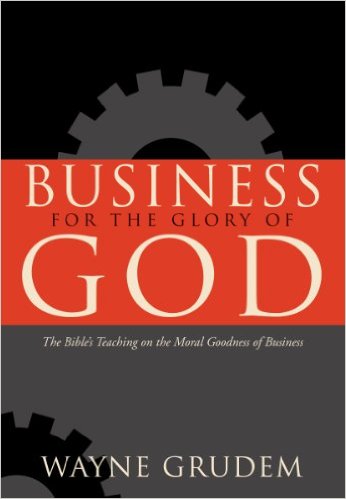
I’ll have to be honest, I’ve not always considered the activity of business and all that it entails to be particularly glorifying to God. As many times as I (along with many people in the world) have been deceived, cheated, or suffered hardship in employment, business has not always been viewed as a positive field to pursue or participate in. One certainly does not think of glorifying God when he hears the term business. But in his book, Grudem applies one of the most fundamental doctrines in all of Scripture to the practice and convention of business. This foundational doctrine is being created in the image of God, and Grudem shows how this doctrine is illustrated through the means and activity of business. In fact, not only is business an excellent way to demonstrate this truth, it is even a necessary way to demonstrate it. The basic premise of the book is that the various aspects of business provide many opportunities to glorify God (because we are created in His image), but also many temptations to sin (because of the Fall). The many components that make up what we consider to be business are clear expressions of the responsibilities and privileges that come with being created in the image of God. Grudem deals with all of the individual aspects of business, expounding on how each of them reflect God’s perfect attributes that were meant to be displayed in us because we have been created in the image of God. According to Grudem, being created in the image of God (as Genesis 1:27 portrays) is imitating Him and having His wonderful attributes reflected in us. And in more ways than many of us have ever considered, business accurately and vividly displays God’s attributes, as we conduct ourselves in a way that reflects His character in us.
First, Grudem explains how ownership of possessions imitates the character of God. Basically, it does so because just as God exercises absolute sovereignty over the entire universe, we as humans created in His image can also exercise sovereignty over a tiny portion of the universe. But as with anything that God created good, and because of the effects of the Fall, ownership of possessions can also provide many temptations to sin. Second, he discusses productivity and how it reflects the character and nature of God. It does so because just as God has wisdom, knowledge, skill, strength, and creativity, we can also imitate those attributes by inventing and creating goods and services that will be beneficial to others. Again, there are also temptations to sin in productivity, such as focusing on material things for their own sake. Third, he deals with how even employment exhibits God’s character. We can glorify God in our employer/employee relationships by imitating the relationship between the Father and Son in the Trinity. The temptation to sin in this way comes from an improper exercising of authority in employer/employee relationships. Fourth, he analyzes the subject of commercial transactions, and how they relate to God’s character. We can imitate God’s character every time we buy and sell, if we do so with honesty, faithfulness to our commitments, fairness, and freedom of choice. We can even reflect the interdependence and interpersonal love among the members of the Trinity by doing so. Still, temptations to sin are very present. We can sin by being greedy, or having our hearts be overcome with selfishness.
Fifth, he points out how making profit(s) from business portray God’s attributes and character. It goes back to being created in the image of God, for through obtaining profits, we make good and efficient use of the earth’s resources. We exercise dominion over them. Additionally, we can reflect God’s attributes such as love for others and wisdom as we make profits from our goods and services. Once more, there are temptations to sin in making profits, just as there are in any other aspect of business. Sixth, he describes how money relates to reflecting God’s character. It is a means to invest and expand our stewardship and imitate God’s sovereignty and wisdom. Through it, we meet our own needs and imitate God’s independence, and we can even give it to others, reflecting God’s mercy and generosity. And as Grudem points out in every chapter, the temptation to sin is prevalent with the use and possession of money. But the distortion of a good thing like money should not lead us to believe that it is inherently evil. Seventh, he explains the issue of the inequality of possessions, and how it can be glorifying to God. Grudem points out how God has unequally entrusted stewardship to various people. This is because He has gifted everyone in different ways. Eighth, he deals with competition and how even this can glorify God. It does so by providing many opportunities to manifest the God-like abilities that we’ve been granted by God. What competition does is enable each person to find a specific role in which they can contribute to society and the good of others. Ninth, he discusses borrowing and lending and how they relate to the glory of God. Borrowing and lending are closely related to the use of money, for proper practice of the two actually multiply the usefulness of money many times over. It multiplies our ability to enjoy God’s material creation, and thus increases our opportunities to be thankful for those things. In addition, we can show forth God’s trustworthiness, His honesty and wisdom, as we borrow and lend. But there are several temptations to sin, but nonetheless, it is a good thing fundamentally.
In the final part of the book, Grudem deals with the most fundamental facet of doing business: the attitudes of our heart. If all the activities of business are to be glorifying to God, then we must engage them all with a heart attitude that is pleasing to God. All business activity tests our hearts, according to Grudem. While ownership, productivity, employment, commercial transactions, profit, money, inequality of possessions, competition, borrowing and lending all provide the opportunities to glorify God and demonstrate His character—the temptations to distort those things (which are fundamentally good) are very present. But if we love God above all, we will reflect the character of God in all of the aspects of business. And finally, in the last chapter, which serves as sort of a footnote to the entire book, Grudem discusses the impact that business can have on the poverty-stricken world. He argues that the practice of business, of selling goods and services for a profit is the only way poverty can be defeated in places where the economy is very poor. Having read the entire book, I highly recommend it to not just people with a negative view of business in general, but also to Christians who seek to understand what it means to be created in the image of God.
That annoying alarm wakes us up. We grab a shower and a cup of coffee, then we’re out the door on our way to work. We might listen to a sermon on the radio during our morning commute, or we might read the Bible at lunch time. And soon enough, it will be time to go home. We go home, do a few things around the house, cook supper, pay bills, and then we’re off to bed to restart the process. But here’s a pressing question: when did we stop and talk to God, and really spend some time praying to Him? If you’re answer is anything like mine, you might feel a bit of shame. Most of us would likely admit that we haven’t been praying as much as we should be. For me, reading the Bible isn’t a problem. I’ve got a Bible reading plan that keeps me in line. But prayer . . . that’s another story. It is difficult for me to find time in my busy day to really spend time with God. That’s an honest confession.
I read something in the Scripture today that drove me to prayer this morning. It’s something I’ve read dozens, probably hundreds of times before. But a few details helped my understanding and application of it. What I read today was Luke 5, the verse that convicted me to prayer was v. 16 where Luke notes that Jesus prayed at His busiest moment at the beginning of His ministry. It reads in this way:
“But he would withdraw to desolate places and pray” (Luke 5:16).
In this passage, Luke records Jesus cleansing a leper saying that once He healed this leper, “even more the report about him went abroad, and great crowds gathered to hear him and to be healed of their infirmities” (v. 15). Jesus cleansed this leper, and word got out about His healing power. Because of this, crowds came to hear Him preach and teach, and they came to be healed of their many diseases and infirmities. Jesus was getting popular at this point. More and more people began to know about Him as time went on. And Luke says that there was one thing He would always do, even when He was busy with His teaching and healing ministry: He would withdraw Himself from the crowds, to places where He could be alone, and He would pray. There are several passages of Scripture in the gospels that tell us that Jesus prayed alone, prayed for others, and prayed long prayers (Matt. 11:25-26; Matt. 14:23; Mark 1:35; Luke 6:12; 22:41-44; 23:24; John 17:1-26). The fact that Jesus prayed is astounding for two main reasons. First of all, because He was God in the flesh, and still prayed. Because He was God, it would make you think that Jesus would not need to pray, but it is very apparent from the gospels that prayer is something that He needed and something that He did. Though Jesus was God, He prayed to His Father and He made use of prayer.
Second, it is astounding that Jesus prayed because He was occupied with more tasks than any of us ever will be, and He still found time to pray. We might say, “But Jesus didn’t have a full time job like I do. Jesus’ didn’t cook supper for children, or pick them up from school everyday like me. Jesus didn’t have emails to send and receive.” Historically, that’s absolutely true. Jesus wasn’t a factory worker, working from nine to five. Jesus didn’t go to see His children play football at the high school. Jesus didn’t have an iPhone and wasn’t able to Tweet or check emails. But let me tell you what Jesus was involved in doing: Jesus was teaching crowds of hundreds of people everyday, and they were increasing as He became more popular. When is the last time you taught growing crowds of people multiple times a week? He was healing all kinds of diseases, people were coming to Him to be healed of all their infirmities and sicknesses. When is the last time you cleansed a leper? He was calling and teaching His disciples. He was dealing with the persecution of the religious rulers. Everywhere He went, He had to walk. When is the last time we did any of those things? And here’s the biggie: no one else could duplicate Jesus’ ministry. No one else could do what He was doing. It would be different if Simon Peter could heal the same way Jesus was, and teach the same way He was. But there was only one Son of God, and there was only one ministry that could do all this: Jesus’ ministry. Jesus was one busy man.
So even though Jesus was God, and even though He was unbelievably busy, nothing seemed to deter Jesus from spending extensive time in prayer. So we need to reflect now on our own prayer life. In light of this passage of Scripture, what is keep us from spending time in prayer? Whatever it might be, we need to get it out of the way and spend time alone with God, taking our requests to Him, praising Him for His blessings upon us, and praying for His grace and enabling to be obedient. I’ve said it before, and it’s something I have to constantly remind myself of: if you are too busy to pray, you are too busy. Let us pray, and let us devote time to prayer. Jesus did, so should we.
I just finished eating roasted turkey, dressing, corn, mashed potatoes and . . . now I’m going to have to get another plate. So while we are feeding ourselves this Thanksgiving Day, I want to offer you a plate of theology to enjoy on this great holiday. There is much to learn from the Scriptures about thanksgiving, that is, giving thanks. We’re going to glean from Psalm 100, and see a couple of principles to use while we give thanks not only today, but in our daily lives.
In Psalm 100, we have what you might call a manual for thanksgiving. In this chapter, the people of Israel were called to give thanks to the Lord. It serves as both a song and instruction on giving thanks. The Israelites would gather for worship, and this would be one of the things they would sing. This psalm/hymn was likely sung during one of their many festivals. The Israelites had a ton of festivals, and this was one of the psalms that was likely sung during one of those. This Psalm will show us how we should give thanks to the Lord, and why we should do so.
So let’s begin by reading it together.
The Text: Psalm 100, ESV
“A Psalm for giving thanks.
Make a joyful noise to the LORD, all the earth!
2 Serve the LORD with gladness!
Come into his presence with singing!
3 Know that the LORD, he is God!
It is he who made us, and we are his;
we are his people, and the sheep of his pasture.
4 Enter his gates with thanksgiving,
and his courts with praise!
Give thanks to him; bless his name!
5 For the LORD is good;
his steadfast love endures forever,
and his faithfulness to all generations.
1. A Celebration of Song (100:1-2)
Giving thanks should be expressed in song/gladness.
In verse one, we see that the whole earth is summoned to make a joyful noise to the Lord. It is an invitation to worship and give thanks that is extended to anyone: “A Psalm for giving thanks. Make a joyful noise to the LORD, all the earth! Serve the LORD with gladness! Come into his presence with singing!” (vv. 1-2)
Here, a joyful song is to be sung to the Lord. When the Israelites would gather for worship, this is one of the many ways they would express their worship of God. They used several instruments in their worship (Psalm 150:3-5). So according to this psalm, one way that we can express our thanksgiving to the Lord is by a song. Do you ever sing to the Lord? You don’t have to sing aloud to the Lord, because a song can also be in your heart.
We are also called to serve the Lord with gladness. Gladness is a feeling of joy or pleasure, to be delighted in serving the Lord. Since we are approaching the Christmas season, I want you to think back with me to Christmas when you were a kid. Now remember that gift you really, really wanted as a kid. Remember the Christmas when you actually got it? You were probably like me, and deserved coal from Santa or a bag of switches. But anyway, man opening that gift you really wanted was a joy wasn’t it? It was what you asked for, and when you opened it up, your heart was full of gladness and delight. That’s how worshiping and giving thanks to the Lord should be. We should have that same kind of gladness when we think of all the gifts God has given us.
2. A Celebration of Covenant (100:3)
Giving thanks should be intimate.
We’ve already seen that giving thanks should be expressed in song, and in this verse we see that giving thanks should be intimate. The psalmist writes, “Know that the LORD, he is God! It is he who made us, and we are his; we are his people, and the sheep of his pasture” (v. 3). As we give thanks with joyful song, we are called to know the Lord. This only makes sense, for giving thanks to the Lord can only be done if we know Him. Giving thanks to the Lord includes knowing the Lord we worship. You can’t properly worship Him without knowing Him—that is, in a personal relationship.
That’s exactly what the author of this psalm is trying to say. In fact, the Hebrew word for “know” here is yada, which means to know intimately, or to have a deep intimacy. Much like the intimacy between a husband and a wife. Isn’t it interesting that the term knew is how Genesis describes Adam and Eve’s intimate relations? In Genesis 4:1, it says that “Adam knew Eve his wife, and she conceived and bore Cain.” If you’ve ever heard someone ramble on and say yada, yada, yada, in actuality they’re saying know intimately, know intimately, know intimately!
Our relationship with the Lord is that way. In fact, the New Testament describes our relationship with Him in terms of a Bridegroom, who is Jesus, and the Bride, the Church (Matt. 25:1-13; Eph. 5:25-27; Rev. 19:6-10). So the idea here in this psalm is that we must have an intimate relationship with the Lord, and our giving thanks to Him should be personal, ongoing, and one-on-one. Our giving thanks to Him needs to be something we do in our private lives. When we get an A on a test, we should thank Him in our hearts. When we wake up, we should thank Him. When we’re about to go to bed, we should thank Him. When we read His word we should thank Him. It’s one-on-one.
Not only must we know the Lord, we also must know that we are accountable to Him: He created us, He owns us, we are His people, and we are His sheep. The psalmist talks about the ownership of God, saying that He created us, we are His, we are His people, and we are the “sheep of his pasture.” He tends to us like a faithful shepherd. These are terms that describe, once again, our closeness to the Lord. We must know Him, and because we know Him, we are His completely. So when you give thanks to the Lord, is it weak and heartless, or is it passionate and intimate? Do you understand your relationship with Him like that?
3. A Celebration of Thanksgiving (100:4)
Giving thanks should be corporate/together.
We’ve already seen that thanksgiving should be expressed to the Lord in song, and that our thanksgiving should be intimate with the Lord, but notice also that our thanksgiving should be expressed together—it should be corporate. This is another call to praise, like vv. 1-2 above. The psalmist says, “Enter his gates with thanksgiving, and his courts with praise! Give thanks to him; bless his name!” (v. 4). Notice the terms gates and courts here. This is clearly referring to corporate worship that would take place in the Old Testament temple. It is an invitation to community worship. It is a call to enter the temple of God with an attitude of thanksgiving—to enter his courts with worship and praise. This was the purpose of the Israelites’ gathering—to give thanks to the Lord. They were to give thanks as they prayed, as they read the Scriptures, as they sacrificed, and as they gave. Even Jesus did this, as we see recorded in Luke 4. Luke writes there, “And he came to Nazareth, where he had been brought up. And as was his custom, he went to the synagogue on the Sabbath day, and he stood up to read” (v. 16). He went to the Jewish place of worship on the Sabbath day and took part in the service by reading the scroll of Isaiah (see v. 17). Basically, Jesus went to church. He valued corporate worship, and so should we.
It bothers me when people say, “I’m a devoted Christian, but I don’t go to church because I don’t believe in it.” Corporate worship is laced throughout the whole of Scripture; Jesus attended corporate worship; it is how we grow in our faith and are equipped to do God’s will (Eph. 4:12-16); and the local church is the representation of the worldwide church of God scattered throughout the earth. When we gather for worship in our local churches, our services should be saturated with thanksgiving. We are to enter our sanctuary doors with thanksgiving, and as we fellowship, sing, and learn from God’s word, we are to do so in His courts with praise and thanksgiving.
4. A Celebration of God (100:5)
Giving thanks should be done because of God.
So we know that our thanksgiving should be expressed in song, it should be intimate, and it should be corporate. Finally, we see in this manual of thanksgiving that our giving thanks should be done because of God and who He is. The psalmist writes, “For the LORD is good; his steadfast love endures forever, and his faithfulness to all generations” (v. 5). Three reasons are given for giving thanks to the Lord. First, we are to give thanks because “the LORD is good.” I love the old saying, “God is good all the time, and all the time God is good.” There is so much truth in that statement. God is completely good in His nature and everything He does. We are to give thanks because He is a good God. Second, we are to give thanks because “his steadfast love endures forever.” Because He is a good God, His love for us endures forever. It is a constant love that never ends. That should definitely be a reason to give thanks to the Lord! He loves you with an eternal love! Finally, we are to give thanks because “his faithfulness [extends] to all generations.” God’s faithfulness never runs out, they are in fact new every morning (Lam. 3:23-33).
Conclusion
We’ve seen in this Psalm that our thanksgiving should be expressed in song and gladness. It should also be intimate, one-on-one with the Lord. It should be corporately expressed, together as we gather for worship. And it should be done because of our good, loving, and faithful God.
If you’re like me, every time I get new tech, I always throw away the manual. Heck, I can figure it out for myself . . . until there’s a problem. Then I have to go to the professionals and have them check it out. And most of the time it’s a simple problem that could’ve been resolved easily if I had only read the manual! Well, let us not make the same mistake in our thanksgiving lives. We have in this Psalm the very manual for thanksgiving, instructions on how to give thanks. So let us use it, cherish it, and use these principles in our lives so that our thanksgiving won’t need to be fixed or repaired.
Following Bro. Nicholas’ message on missions emphasis, we had a panel discussion on missions. Several questions were submitted to us that we attempted to answer on this panel, that you can listen to below:
What is/are missions?
Does God call all Christians to missions?
How do I know if I’m called to missions?
Why are missions so expensive?
How can I be mission-minded?
WATCH THE PANEL DISCUSSION HERE:
I invite you to listen to his message that was preached that night also. You can hear it by clicking here: Missions Emphasis Message.
“As His followers, we are His hands, we are His feet, we are His mouthpiece. And it is our duty to make His word known.”
Recently at our church, we had a missions emphasis night with our students. We focused on unreached peoples, we prayed, and we heard a great message from Bro. Nicholas J. Rafael from Murphysboro, IL. This was a great message on missions, and I invite you to take a few minutes out of your day to listen/download his message below:
Be sure to check him out on Facebook, and to listen to our panel discussion that also took place that night by clicking here.
“. . . Teaching you in public and from house to house” (Acts 20:20)
Let’s imagine for a moment that, since the birth of Christianity as recorded in the book of Acts, no one ever built a church building. Never. No one took into consideration that a large number of believers could meet in a large building for worship. But believers still need to meet for worship because it’s biblical . . . So where would they meet? The most convenient place would be in homes. That’s the next best thing to gathering for worship in a church building, isn’t it? Bible study and worship in your own home. Well, that’s exactly where the early church met for worship before there was ever one brick laid in construction of a church building (Acts 2:46; 20:20; Rom. 16:5; 1 Cor. 16:19; Col. 4:15; Philemon 2).
Many churches are still following this model for “doing church” even today, and they should be because it is both biblical and strategic for reaching people for Jesus Christ with the gospel. First it is biblical. It is biblical because it is usually only a smaller version of our regular corporate worship gatherings at our own local church. The Bible commands and exhorts us to meet together with other believers (Psalm 150:1-6; Matt. 18:20; Heb. 10:25; 1 John 1:7). You cannot be a growing, thriving believer if you’re not attending and participating in a local church somewhere. So meeting in a home for worship and Bible study, or meeting in a community center or restaurant is only a condensed version of what you would normally do with more believers in a larger setting and building. Second it is strategic for reaching people for Christ. Most people today, especially today, have their preconceived assumptions about the church. With this in mind, people are far easier to reach with the gospel in your home or out in public, than they are in the church. When you think about it, that is actually essential to the way evangelism is supposed to be done. People will respond more positively to an invitation to your home than they will an invitation to a church they know nothing about. You can reach them with the gospel in your home, and then they are far more likely to attend your church and continue attending your church. We need to be reaching people with the gospel and bringing them into our churches in non-threatening ways. We’re not changing the message of the gospel, only the means through which we present it. We can have a bonfire at the house, a cookout, we can meet for lunch with a couple of friends, and the list goes on and on – there are several available options for meeting places, which makes it that much more strategic for reaching people for Christ.
So you want to start doing this. You want to get this thing going. You want to be biblical and you want to reach people for Christ through our own home and community. Well, there are at least three things essential to these “in-home” church groups. Three things that you need to keep in mind in order to start and sustain groups in your community or home:
1. Focus. You need a missions-focused church that is on board and ready to do smaller churches in homes. I believe we should excite our church members by sharing with them this model of doing church, and encouraging them to participate in and support it. If no one else in your church is concerned about outreach, you should be concerned about your church – they are destined to close their doors. Your entire church needs to be focused on reaching people with the gospel in this way. It might take some time to get members informed about this, and excited to participate, but your time will be well spent if you do so. This is something that should be consistently promoted in your local church. Both you and your church should have a continual focus on meeting in homes, so that members can participate and do the same thing you’re doing.
2. Training.You need people who are trained, at least in some way, to teach the Bible – leading those Bible studies, able to answer tough questions, able to lead others to Christ, and things of that nature. Someone in your church may have an earnest desire to be involved in small groups that meet in homes, but if they haven’t ever taught a Bible study, they need some type of training where they can learn how to do so. It doesn’t need to be formal Bible college training per se, but they need to know the basics because one day they will teach someone else to be a teacher of the word. You and your church should have people who are fully prepared.
3. Resources. Anytime something like this is done, you need resources. You need financial resources, literary resources, and a place to meet. Your home should be a place where you can meet for Bible studies. If it’s a one bedroom apartment, it’s probably not the best place to meet. Perhaps you can meet in your local park or in a restaurant or coffee shop. You also need literary resources: Bibles, Bible study booklets, books on the Bible, gospel tracts, etc. Those things will contribute to your overall outreach. Many people you will have in your home or meeting place do not have resources like this. All of this will require some type of financial support. Are you financially able to carry out a continuous small group Bible study? Are you financially able to have cookouts or snacks around the table when you meet for fellowship?
Those are a few things to keep in mind as you have “in-home” church groups. Is there anything else would you add?
A tool can be very valuable if we learn how to use it. The worker is never without his hammer, because of its many uses. If he believed that a hammer had only one use, say for driving nails, then he probably wouldn’t value it as much. But he can likely accomplish two-thirds of his daily tasks all by using a hammer – but he must know how to use it. In order to get the most use from it, he must know how to use it.
So it is with the word of God, the Bible. It is our theological toolkit for living the Christian life. We need it to grow in our faith and be the Christian that God has called us to be. No believer can be obedient to God without the Bible, so it is important that we use our Bibles effectively. The Scriptures are profitable to our Christian growth (2 Tim. 3:16), but we must know how to use them. So how can we get the most use out of our Bibles? I believe there are five basic ways we can get the most use from our Bibles:
1. Read the Bible. This is the most basic way we can use the Bible. Do you read the Bible every day? Everyone reads and learns at a different pace, so it may take some time to adjust to reading the Bible regularly—but perhaps the best way to read it is by reading a few chapters a day, in the morning and the night. A good Bible reading plan is also very helpful—helps keep you accountable and track your progress. We must take time out of our busy schedules to read God’s word. If you’re too busy to read the Bible, you’re too busy. The good part about it is that the more we read it, the more we will want to read it, and the more we will be equipped with its teachings.
A while ago, I did a little math to calculate how long it would take someone to read through the entire Bible. The Old Testament, consisting of 929 chapters, would only take you 26.5 weeks to read all the way through if you read 5 chapters a day. That’s reading through the entire Old Testament in about 6 months. The New Testament, consisting of 260 chapters, would only take you 7.4 weeks to read all the way through if you read 5 chapters a day. That’s Matthew through Revelation in under 2 months. If you read 5 chapters of the Bible daily, you could read through the whole Bible once and read half of it over again. . . In a year. In a small 5 year period, you will have read through the entire Bible nearly 8 times.
2. Meditate on the Bible. This is not simply a suggestion, for the Bible implies that we should meditate on the Scriptures (Psalm 119:15, 48, 97). Do you remember the first Psalm about the godly man who was blessed in every way? How did he get blessed? How did he become so prosperous? It was because “his delight [was] in the law of the LORD and on his law he meditates day and night” (Psalm 1:2). Scripture meditation involves pondering and thinking deeply on what we’ve read. We think about what they mean for us, and ponder how to put them into action. Meditation involves allow the Scripture to dictate our thought lives—to let it swim and boil in our hearts and minds throughout our daily commute. Do you have some Scripture that you’ve been meditating on?
3. Pray the Bible. Many people do not realize the benefits of this or see that it’s even necessary, but praying the Bible helps us to align our prayers to God’s will. That’s the only kind of prayers God answers anyway—according to His will: “And this is the confidence that we have toward him, that if we ask anything according to his will he hears us. And if we know that he hears us in whatever we ask, we know that we have the requests that we have asked of him.” (1 John 5:14-15). God’s will is revealed in the Bible, so if we want to pray according to God’s will, wouldn’t it make sense to pray the Scriptures? Sometimes we pray for the wrong things, but if we want to pray for the right things, we need to be praying the Scriptures. When you’ve read your Bible each day, let what you read compel you to prayer, and then pray about what you’ve read.
4. Memorize the Bible. This one, like the others, seems to be implied by the Bible itself as a command. We are familiar with Psalm 119:11, “I have stored up your word in my heart, that I might not sin against you.” The psalmist there says that his defense against sinning was that he had stored God’s word in his heart. Scripture memory involves not only getting into the Bible, but allowing the Bible to get into us. It is allowing the word of Christ to dwell in us richly (Colossians 3:16). Scripture memorization involves taking time to memorize the Bible, whether a few verses or a few chapters. It is very beneficial, for we can call to mind a Scripture that is especially helpful for us in a time of need or for someone else in a time of need. Because the Spirit of God can’t call to your memory a Scripture you’ve never read or memorized. Do you take time to memorize the Bible? You can write it out on paper until you have it memorized, or you can repeat it back to yourself time after time, or you can simply read it over and over again. I’ve put Bible verses on note cards and slipped them in my pocket as I go about my daily tasks. That way, when I get my keys or phone out, I can always look at that verse first.
5. Study the Bible. Studying the Bible is key. It involves the most effort, but yields the best results. Studying the Bible is observing it, interpreting it, and applying it to our daily lives. We might spend a while studying a verse of Scripture, a chapter, or a whole book of Scripture—but studying involves doing much work to excavate the deep truths of Scripture. A good study Bible helps with this, good commentaries, or other helpful books like Bible dictionaries and Bible handbooks. In studying the Bible, we focus on it—think through it intellectually and emotionally. We discover what the particular author is saying about his subject and what it means for us today. Do you study the Bible? How much time a week is spend studying the Bible?
Every Christian faces temptations, and they can come in all different shapes and sizes. The lay workman may be tempted to call his boss something vulgar. The pastor may be tempted to give up on his ministry. The teenager may be tempted to watch pornography. The believing sister may be tempted to keep quiet about the gospel in conversations with her unbelieving brother. Whatever the temptation may be, this facts stands true: we all face temptations.
So the first thing to understand is that you should not despair when you face temptations, because everyone has them. Scripture says, “No temptation has overtaken you that is not common to man” (1 Cor. 10:13a). Paul says here that there isn’t a single temptation that only you are facing. All of mankind faces them. It is even a temptation within a temptation to believe that we are the only ones who struggle with certain sins or desires. But the Bible clearly teaches that believers are still fighting sin, and thus, all face temptations. So don’t feel like you’re the only one.
Secondly, you need to understand that temptation can be overcome. Turning again to 1 Corinthians, Paul continues: “God is faithful, and he will not let you be tempted beyond your ability, but with the temptation he will also provide the way of escape, that you may be able to endure it” (v. 13b). The hope we can have in our temptations is that God is faithful, and that He has provided “the way of escape.” While God does not cause temptations (James 1:13), He does want you to endure them and come out victoriously. And the way He does this is by providing for us the way of escape. But we must be willing to take that route and pursue His way of escape. I have a few practical, biblical suggestions for overcoming temptation in your life and fleeing through God’s way of escape:
1) Study and know yourself. It’s good to take a long look in the mirror sometimes isn’t it? We need to know what desires we have a problem with and what situations or people cause us to enter into temptation. What desires do you have a problem with? Find out what situations, places, or people, cause you to have desires for sin. Study and know yourself well. Ask God to reveal that to you as well. Pray with David, “Search me, O God, and know my heart! Try me and know my thoughts! And see if there be any grievous way in me, and lead me in the way everlasting!” (Psalm 139:23-24).
2) Avoid tempting situations. Keep yourself away from the situations that cause you to sin against God and fall into temptations. You know it does no good to pray, “Lord deliver me from evil,” if we thrust ourselves into it. I heard an old preacher say, “You can’t pray “Deliver me, Lord, from temptation,” if you thrust yourself thither!” Avoid the situations that cause temptations. Don’t park a freshly washed car under a tree full of birds. In other words, don’t try to be clean when you willingly go into areas that will make you dirty! The writer of Proverbs presents a picturesque warning for us concerning flirting around with sin, “Can a man carry fire next to his chest and not be burned?” (Proverbs 6:27). Indeed not.
3) Submit to Christ. When we get saved, we make Jesus our Savior and Lord. He is our Savior because He saved us from death, hell, and the grave. He is our Lord because He takes control. But that’s the part that gets us sometimes. There may be areas of our heart that we haven’t submitted to Christ and made Him Lord over. But we must submit to His leadership and will and allow Him to take control of all the areas of our heart—including our desires. It is taking “every thought captive to obey Christ” (2 Cor. 10:5).
4) Get satisfaction from God. Desires seek to be satisfied. If they didn’t, they wouldn’t be desires. So since desire is the problem, then our desires need to change. How can that be done? By getting our satisfaction from God. If you don’t believe that God can satisfy you, David invites you to “Taste and see that the Lord is good! Blessed is the man who takes refuge in him!” (Psalm 34:8). Similarly David says to “Delight yourself in the Lord, and he will give you the desires of your heart” (Psalm 37:4). It’s like eating your favorite food—you keep eating it because of the satisfaction it brings your belly! When you get hungry, don’t you desire your favorite food? Of course you do, because you have a mental remembrance of the satisfaction it brings. It works in a similar way with God. If we will get our satisfaction from Him, we will inevitably begin to desire Him.
5) Walk by the Spirit. Paul says in Galatians 5:16, “But I say, walk by the Spirit and you will not gratify the desires of the flesh.” He says that if we will live each step of our lives submitted to the power and presence of the Holy Spirit, we will not fulfill or carry out our sinful desires. The Spirit of God lives in us to enable us to live the Christian life victoriously and He will give us the power to overcome sin if we will submit to Him and walk by Him.
Friend, do not despair. Every believer faces temptations, and every believer can overcome temptations by taking God’s way of escape. Are you willing?






 Brandon's Desk