

Far from something we can acquire by meritorious works, justification is the legal act whereby God declares sinners as righteous solely because of the finished work of Christ. In the once-for-all work of justification, the Judge of all the earth (Gen. 18:25) pronounces guilty sinners as “not guilty” because of the double imputation which occurred on the cross, where God imputed the believer’s sin to Christ and imputed His perfect righteousness to them. Thus, justification has “two sides,” namely, the removal of sin’s punishment (since it was paid by Christ), and the “crediting” of righteousness to the believer’s account (since Christ lived a perfectly righteous life). Therefore, it can rightly be said that Jesus did not merely die for sinners; He lived for them. The great exchange of justification, then, is the transferal of the sinner’s guilt to Christ (although He was sinless) and the transferal of Christ’s righteousness to the sinner (although he is sinful). As Paul aptly stated in 2 Corinthians 5:21, “For our sake he made him to be sin who knew no sin, so that in him we might become the righteousness of God.”
Moreover, justification via the finished work of Christ is the only legitimate and just way for sinners to become righteous in God’s sight without jeopardizing God’s own moral demands or holiness (cf. Romans 3:21-26). The Scripture is clear that God is too just to ignore, forget, or even forgive sin without full payment of its penalty. The “wages of sin” and “the record of debt” must be paid in order to satisfy God’s righteous indignation toward sin and sinners (Rom. 6:23; Col. 2:14). Additionally, God is too holy to allow anything less than absolute righteousness and perfection to dwell in His eternal presence (Psalm 15:1-5; Matt. 5:48). And in Christ’s work of justification, He meets both demands: God’s just wrath is propitiated by His atoning sacrifice, and God’s demand for righteousness is met by the crediting of Christ’s righteousness to those who lay hold of justification by faith.
Furthermore, justification is evidently a single decisive event, rather than a continuous process to which we contribute through good works. Because justification is a legal act of acquittal, it fundamentally cannot be a “process of reform.” A judge’s sentence cannot be reversed, revoked, or revised; once the gavel is swung, the case is closed. Likewise, the Lord as Judge has “closed the case” for those who are justified by faith, and His word that is “firmly fixed in the heavens” (Psalm 119:89) is this: “Who shall bring any charge against God’s elect? It is God who justifies” (Rom. 8:33). Additionally, the Scripture attests to the finality of justification in saying that Jesus’ death was, “once for all” (Rom. 6:10; Heb. 9:26), as even Jesus proclaimed from the cross: “It is finished” (John 19:30).
Ultimately, believers are “justified by his grace as a gift” (Romans 3:24a; cf. Eph. 2:8-9). This is because, by definition, justification cannot be achieved through good works (as stated above). As Paul taught in Galatians, “Yet we know that a person is not justified by works of the law but through faith in Jesus Christ, so we also have believed in Christ Jesus, in order to be justified by faith in Christ and not by works of the law, because by works of the law no one will be justified” (Galatians 2:16). Paul also taught just as Abraham believed and it was “counted to him as righteousness,” so God also counts Christ’s righteousness to the believer when they believe in Him and receive justification as a gift of His grace (Romans 4:1-12; cf. also Romans 5:1). Moreover, Paul stated that Christ died for no reason if justification is by any other work than His meritorious work: “I do not nullify the grace of God, for if righteousness were through the law, then Christ died for no purpose” (Gal. 2:21).
God would simply be an unjust judge if justification could be received by good works. A corrupt judge is one who reduces a criminal’s sentence or fully pardons him based on the “good” he has done in his life. The criminal cannot tip the scales in his favor, as though his good deeds could outweigh his guilt. Justice demands that he be punished for his misdeeds, and a good judge will make certain that he is. And in the work of justification, God not only justly punished sin in punishing Christ, He also bestows Christ’s “alien righteousness” (Phil. 3:8-9) upon sinners who claim it by faith alone. Therefore, the only good work one needs in order to obtain justification is the finished work of Jesus Christ.




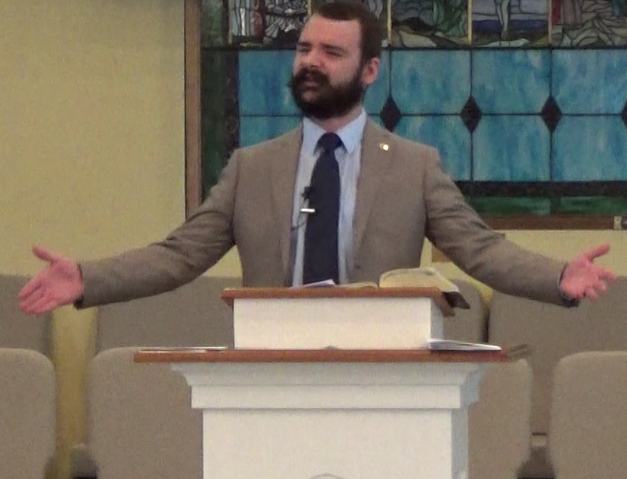 Brandon is the founder and main contributor to Brandon’s Desk, the blog with biblical resources from his ministry. He is proud to be the pastor of the family of believers at Locust Grove Baptist Church in Murray, Kentucky. He and his wife Dakota live there with their three dogs, Susie, Aries, and Dot.

 Brandon's Desk